



Manual vs Automatic Coffee Brewing: Which Is Better?
Table of Contents
- Manual vs Automatic Coffee Brewing: Key Differences at a Glance
- How Extraction and Grind Size Shape Flavor in Each Method
- Pour Over vs Drip Coffee Machine: Control, Consistency, and Results
- Manual Brewing Techniques for Specialty Coffee
- How to Improve Automatic Coffee Machine Flavor
- Time, Convenience, and the Learning Curve
- Equipment Cost, Durability, and Long-Term Value
- Environmental Impact and Space Considerations
- Which Method Should You Choose?
- Frequently Asked Questions
Last Updated: September 18, 2026
Manual vs Automatic Coffee Brewing: Key Differences at a Glance
When you're deciding between manual vs automatic coffee brewing, you're really choosing between two fundamentally different approaches to extraction. Manual brewing puts you in control of every variable: water temperature, pour rate, contact time, and grind size. Automatic machines handle these decisions for you, trading precision for consistency and speed. Neither is objectively "better", the answer depends entirely on what you value in your morning cup.
At Venro Coffee Co., we work with both methods daily, and the difference comes down to this: manual brewing rewards technique and attention, while automatic brewing rewards reliability and convenience. Understanding how each method affects flavor extraction helps you make a choice that matches your lifestyle and coffee preferences.
The real tension isn't between quality and convenience, it's between artistry and predictability. A well-executed manual pour-over can produce exceptional clarity and complexity. A quality automatic machine delivers the same beans with identical results every single morning. Both can make excellent coffee. The question is which trade-off you're willing to make.
| Aspect | Manual Brewing | Automatic Machines |
|---|---|---|
| Control Over Variables | Full control of temperature, pour rate, timing | Limited to preset parameters |
| Consistency | Varies with technique and skill | Highly consistent batch to batch |
| Time Investment | 5-10 minutes active brewing | 2-5 minutes mostly hands-off |
| Learning Curve | Steep; technique matters significantly | Minimal; load and start |
| Equipment Cost | $20-200 for quality manual gear | $100-500+ for quality machines |
| Flavor Potential | High complexity when executed well | Good clarity, less variation |
| Maintenance | Minimal; mostly cleaning | Regular descaling and upkeep |
| Best For | Coffee enthusiasts, home baristas | Busy professionals, consistency seekers |
How Extraction and Grind Size Shape Flavor in Each Method
Extraction is the process of dissolving soluble compounds from ground coffee into water. Get it right, and you unlock sweetness, clarity, and balanced acidity. Under-extract, and your coffee tastes thin and sour. Over-extract, and bitterness dominates. The method you choose determines how easily you can hit that sweet spot.
Manual brewing gives you direct control over extraction through grind size, water temperature, and brew time. With a pour-over, you're actively managing the flow rate, pouring slowly creates longer contact time, allowing more extraction. Pour too fast, and water rushes through without fully dissolving the coffee's soluble compounds. This flexibility means you can adjust mid-brew if something isn't working.
Automatic machines use a fixed brew ratio and preset timing. The machine decides how long water stays in contact with grounds. Some machines offer adjustable brew strength settings, but these typically just change the ratio of coffee to water rather than giving you control over actual extraction variables. The thermal stability of automatic machines, maintaining consistent water temperature throughout the brew cycle, is one genuine advantage they hold over many manual methods.
Grind size is where the real use lives in both methods. Finer grinds increase surface area, speeding up extraction. Coarser grinds slow it down. Manual brewers can dial in grind size precisely to match their technique. With automatic machines, you're locked into whatever grind size works with that machine's flow rate and contact time. Change the grind too much, and you'll either under-extract or over-extract, there's less room for adjustment.
Pour Over vs Drip Coffee Machine: Control, Consistency, and Results
A pour-over dripper puts you in the driver's seat. You control water temperature (ideally 195-205°F), pour rate, and bloom time. The bloom, that initial 30-45 second saturation of grounds before the main pour, allows CO2 to escape and promotes even extraction. With manual brewing, you decide whether to bloom, how long, and how aggressively to pour afterward.
Drip machines automate this entire sequence. Water heats to a preset temperature, flows through grounds at a machine-determined rate, and extracts for a fixed duration. You get identical results every time, which is either a feature or a limitation depending on your perspective. The consistency is genuinely valuable if you're brewing at 6 AM before work. It's limiting if you want to experiment with different flavor profiles.
The flavor difference between the two methods comes down to control over flow rate and thermal stability. Manual brewers can adjust pour speed to compensate for grind size or water quality issues. If your water is hard or your grind is slightly off, you can pour slower to extend contact time or faster to speed extraction. Automatic machines can't adapt. They execute the same program regardless.
That said, quality automatic machines maintain better thermal stability than most manual brewers can achieve by hand. The machine's heating element keeps water temperature consistent throughout the brew cycle. Manual brewers rely on the heat capacity of the dripper itself, ceramic and glass are better insulators than plastic, but they still lose temperature as hot water flows through. For specialty coffee where precision matters, this is worth considering.
The pour-over method also produces cleaner flavor clarity because you're controlling the bloom and can observe the extraction happening in real time. With an automatic drip machine, you lose that sensory feedback. You can't adjust if something seems off because the brew is already underway.
Manual Brewing Techniques for Specialty Coffee
Manual brewing techniques for specialty coffee demand attention to detail, but they're learnable. The core techniques, pour-over, French press, AeroPress, Moka pot, each have different extraction profiles and require different approaches.
Pour-over brewing (the most popular manual method) starts with the bloom. Pour just enough hot water to saturate the grounds evenly, then wait 30-45 seconds. This allows trapped CO2 to escape and promotes even extraction. After the bloom, pour in slow, circular motions, maintaining a consistent water level in the dripper. The goal is to keep water in contact with grounds for 3-4 minutes total. Too fast, and you under-extract. Too slow, and you over-extract.
Water temperature matters more in manual brewing than automatic because you're not relying on a machine's thermal stability. Aim for 195-205°F. If your water is too hot, extraction accelerates and you'll over-extract. Too cold, and extraction slows, leaving your coffee sour and thin. A simple kettle thermometer solves this.
Grind size is your primary control lever. For pour-over, use a medium-fine grind, slightly finer than sand. If your coffee tastes sour, go finer next time to increase extraction. If it tastes bitter, go coarser to decrease extraction. This feedback loop is what makes manual brewing engaging for coffee enthusiasts.
French press brewing is more forgiving but requires different technique. Use a coarser grind (similar to breadcrumbs) because the immersion method, steeping grounds directly in water, extracts differently than drip brewing. Steep for 4 minutes, then press the plunger slowly. The coarse grind prevents over-extraction during the long immersion. This method produces a heavier body and more pronounced flavor because oils remain in the cup (unlike paper filters).
AeroPress and Moka pot brewing sit between pour-over and French press in terms of control and extraction profile. Both require you to manage water temperature, contact time, and grind size, but the mechanics are different. AeroPress uses air pressure to force water through grounds quickly, producing clean, concentrated coffee. Moka pot uses steam pressure and produces strong, espresso-like results.
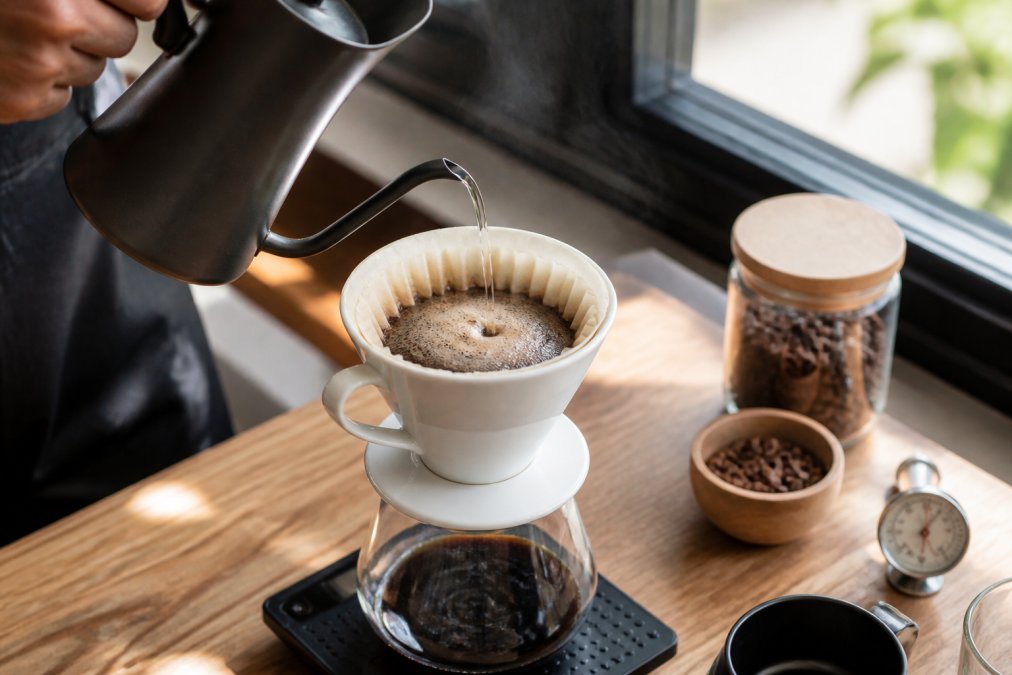
The learning curve for manual brewing is real. Your first 20 cups will likely be inconsistent as you develop feel for pour rate and timing. But that's also the appeal, there's a skill component that makes the ritual more engaging. Once you dial in your technique, manual brewing becomes meditative rather than frustrating.
How to Improve Automatic Coffee Machine Flavor
If you're committed to automatic brewing, you can absolutely improve flavor quality without replacing your machine. The limiting factor isn't the machine, it's usually the coffee itself and how you're using the machine.
Start with grind size. Most people use pre-ground coffee, which loses flavor compounds within days of grinding. Grinding beans fresh, immediately before brewing, makes a measurable difference even in automatic machines. Buy whole beans and grind just before brewing. This alone improves flavor more than any machine adjustment.
Second, use the right grind size for your machine. Most automatic drip machines work best with a medium grind, slightly coarser than pour-over. If your coffee tastes weak or sour, try a finer grind. If it tastes bitter, go coarser. Automatic machines have less flexibility than manual brewers, but you still have this one control lever.
Water quality affects automatic machines more than manual brewing because the machine's heating element and internal passages can accumulate mineral buildup. Hard water creates scale inside the machine, reducing thermal stability and affecting extraction. If your tap water is hard, use filtered water. Descale your machine monthly with white vinegar to remove mineral buildup. This maintenance directly improves flavor.
Coffee-to-water ratio matters more in automatic machines because you can't adjust extraction mid-brew. Use the machine's markings as a starting point, then adjust based on taste. If coffee tastes weak, use more grounds. If it tastes bitter, use less. Most machines come with a measuring scoop, use it consistently.
12 Pack Single Serve Coffee Capsules →
The final factor is brew time. Automatic machines typically brew 8-10 minutes for a full pot. This is longer than manual brewing because the machine's heating element isn't as efficient at maintaining temperature. If your machine has a brew strength setting, use it. Many machines offer "bold" or "strong" settings that simply extend contact time, increasing extraction.
Time, Convenience, and the Learning Curve
Manual brewing takes 5-10 minutes of active time. You're pouring water, watching the bloom, adjusting pour rate. This is part of the appeal for some people, the ritual becomes part of your morning. For others, it's a barrier. If you're rushing out the door, manual brewing isn't practical.
Automatic machines take 2-5 minutes of hands-on time. Load grounds, add water, press start. You can walk away and come back to finished coffee. The machine handles extraction while you shower, check email, or prepare breakfast. This convenience is the primary reason automatic machines dominate household coffee.
The learning curve differs dramatically. Manual brewing has a steep initial curve, your first cups might be mediocre while you learn technique. But the curve flattens quickly. After 20-30 brews, you develop intuition for pour rate and timing. The skill is learnable and repeatable.
Automatic machines have a flat learning curve. Load, press start, drink coffee. There's minimal technique to master. The trade-off is that you're locked into the machine's parameters. You can't innovate or adjust beyond a few basic settings.
For busy professionals, automatic machines win on convenience. For home baristas who enjoy the brewing process, manual methods win on engagement and control. There's no objective winner, just different priorities.
Equipment Cost, Durability, and Long-Term Value
Manual brewing equipment is cheap to start and built to last. A basic pour-over dripper costs $15-30. A gooseneck kettle runs $30-50. A burr grinder adds $40-80. Total initial investment: under $150 for quality gear. These tools last years with minimal maintenance because they have no electronic components to fail. A ceramic dripper never wears out. A glass carafe is replaceable if broken. A metal or cloth filter is reusable indefinitely. A burr grinder's burrs may need replacement after 5+ years of heavy daily use, costing $15-30 for a replacement burr set, you keep the same grinder body. This repairability is crucial: you own the equipment outright and can fix it yourself or through any local repair shop.
Automatic machines cost more upfront ($150-500 for a quality drip machine, $300-800 for a programmable model) and require ongoing maintenance that manual brewers don't. Descaling every 30-60 days (depending on water hardness) is non-negotiable; mineral buildup inside the heating element and water lines reduces thermal stability and can cause premature failure. This requires white vinegar, time, and occasionally a commercial descaling solution ($8-15 per bottle). The internal heating element, water pump, and circuit board are the failure points. When these fail, typically between 3-7 years depending on use and water quality, replacement costs $80-200, often approaching the price of a new machine. Most manufacturers don't sell individual replacement parts to consumers; you must send the machine to an authorized service center or replace it entirely. This creates an e-waste problem: a machine that fails after 5 years becomes landfill rather than a repairable asset.
The repairability gap is significant. A manual brewer purchased today will function identically in 15 years. An automatic machine purchased today will likely require repair or replacement within 5-7 years. If you factor in descaling supplies ($10-15/month), replacement filters ($5-10/box), and eventual repair or replacement costs, the true cost of ownership for automatic machines is substantially higher than the sticker price suggests.
However, automatic machines save time, which has financial value. If your time is worth $30/hour and manual brewing takes 10 minutes longer per day than an automatic machine, that's $50/month in opportunity cost. Over a year, that's $600. For time-constrained professionals, this convenience premium justifies the higher equipment cost and shorter lifespan.
The hybrid approach offers middle ground: use an automatic machine on weekdays for speed and consistency, and invest in a $50-80 manual setup for weekends when you have time. This spreads your equipment investment across both methods and lets you choose based on your schedule.
For specialty coffee, manual brewing's repairability advantage compounds over time. A $60 pour-over dripper paired with a $50 burr grinder represents a 10+ year investment in equipment that will never become obsolete or require electronic repair. Automatic machines lock you into a manufacturer's ecosystem; when the machine fails, you're forced to buy a new one or pay for proprietary repairs. Manual brewing gives you ownership and longevity.
Environmental Impact and Space Considerations
Manual brewing has a significantly lower environmental footprint across the entire product lifecycle. A ceramic pour-over dripper, metal filter, or cloth filter produces zero electronic waste. Paper filters are compostable and biodegradable within 2-4 months in standard compost. A burr grinder's only electronic component is a small motor; when it eventually fails after years of use, the metal burrs and housing are recyclable. Over a 10-year period, manual brewing generates minimal waste beyond used coffee grounds (which compost naturally and improve soil). The manufacturing footprint is also lower: ceramic and metal require less energy to produce than plastic housings and circuit boards.
Automatic machines create e-waste at end-of-life. The Environmental Protection Agency estimates that electronics recycling recovers only 35% of discarded appliances; the rest enter landfills. A typical automatic coffee machine contains plastic housing, a heating element, a water pump, a circuit board, and various metal and rubber components. When the machine fails (typically 5-7 years), these materials either go to landfill or require energy-intensive recycling. The manufacturing process for automatic machines is also more resource-intensive: producing the circuit board, heating element, and plastic housing requires more raw materials and energy than producing a ceramic dripper.
Water usage differs meaningfully. Manual brewing uses only the water you need for one cup, typically 8-12 ounces. Automatic machines require a full reservoir (typically 40-60 ounces) and many models waste water during the heating cycle as the machine preheats the internal lines. Some automatic machines cycle water through the heating element multiple times before brewing, increasing total water consumption by 20-30% compared to the actual coffee produced. For environmentally conscious consumers in regions with water scarcity, this matters.
Energy consumption also favors manual brewing. A gooseneck kettle uses 1200-1500 watts for 3-5 minutes to heat water for one cup, consuming roughly 0.06-0.125 kilowatt-hours per brew. An automatic machine uses 750-1200 watts but runs for 8-10 minutes, consuming 0.1-0.2 kilowatt-hours per brew. Over a year, brewing one cup daily, manual brewing uses approximately 22-46 kilowatt-hours annually, while automatic machines use 36-73 kilowatt-hours. The difference is modest for individual households but compounds across millions of users.
The most significant environmental advantage of manual brewing is longevity. A ceramic dripper lasts 10+ years. An automatic machine lasts 5-7 years. Replacing an appliance twice as often doubles the manufacturing impact and e-waste generation. From a lifecycle perspective, buying one $50 manual setup that lasts a decade is environmentally superior to buying two $250 automatic machines over the same period.
Space efficiency also favors manual brewing.
Which Method Should You Choose?
Choose manual brewing if you enjoy the ritual, want to develop brewing skills, have time for 5-10 minutes of active brewing, and value equipment longevity over convenience. Manual brewing rewards attention and technique. It's engaging, environmentally friendly, and produces excellent coffee when executed well. The learning curve is real, but it's surmountable.
Frequently Asked Questions
Is manual coffee brewing better than automatic for specialty coffee?
Manual brewing offers greater control over extraction variables like water temperature, pour rate, and bloom time, which can highlight the nuanced flavor profiles of specialty beans. Automatic machines deliver consistency and convenience but may sacrifice the artistry that brings out subtle notes in single-origin coffees. For specialty beans, manual methods typically unlock more complexity, though the difference depends on your grind size, water quality, and technique.
What's the difference between pour over and drip coffee machines?
Pour-over brewing gives you direct control over water temperature, flow rate, and brewing time, allowing you to customize extraction for different bean profiles. Drip machines automate these variables, providing consistency without requiring technique or attention. Pour-over excels at highlighting clarity and body in specialty coffees, while drip machines prioritize convenience and repeatability. Your choice depends on whether you value customization or speed.
How can I improve the flavor of my automatic coffee machine?
Start with grind size: use a burr grinder and adjust to medium-fine for better extraction. Use filtered water to ensure thermal stability and prevent mineral buildup that affects flavor. Clean your machine regularly to remove oil residue that can cause bitterness. Experiment with brew ratio by adjusting the amount of coffee relative to water. Finally, store beans in an airtight container away from light to preserve freshness until brewing.
Which brewing method is more cost-effective long-term?
Automatic drip machines have lower upfront costs and minimal maintenance expenses, making them economical for daily brewing. Manual equipment (pour-over, French press) requires less electricity and can last decades with proper care. However, manual methods demand higher-quality beans to justify the time investment, which increases per-cup costs. For budget-conscious drinkers, automatic machines win; for those prioritizing quality and willing to invest in specialty beans, manual methods offer better long-term value.