



Is a Burr Grinder Worth It for Home Brewing?
Table of Contents
- The Case for a Burr Grinder: What the Upgrade Actually Changes
- Blade vs Burr Grinder for Home Coffee: The Core Differences
- How Grind Size Affects Coffee Extraction
- Conical vs Flat Burrs: Which Geometry Suits Your Brew
- What Most Reviews Skip: Noise, Retention, and Repairability
- Best Entry Level Burr Grinders for Specialty Coffee
- Is a Burr Grinder Worth It for Your Home Brewing Setup?
- Pairing Your Grind with Single-Origin Beans
- Frequently Asked Questions
Last Updated: September 15, 2026
The Case for a Burr Grinder: What the Upgrade Actually Changes
If you're wondering whether a burr grinder is worth it for home brewing, the short answer is yes, but not for the reason most people assume, and the burr grinder worth question comes down to consistency. A burr grinder doesn't make coffee taste better by magic. It makes coffee taste consistent, and consistency is what separates a cup you tolerate from one you look forward to. This guide from Venro Coffee Co. breaks down exactly what changes when you move from a blade grinder to a burr grinder, where the money actually goes, and when you can skip the upgrade entirely.
Here's the part most guides bury: grind uniformity controls extraction more than your brewer, your water temperature, or your technique. According to the Specialty Coffee Association's brewing standards, extraction happens when water dissolves soluble compounds from coffee particles, and uneven particle sizes mean uneven extraction. Some grounds give up their flavor too fast. Others barely release anything. You taste both in the same sip.
A blade grinder produces a chaotic mix of powder and chunks. A burr grinder produces particles in a narrow size range. That single difference reshapes bitterness, sweetness, body, and aroma.
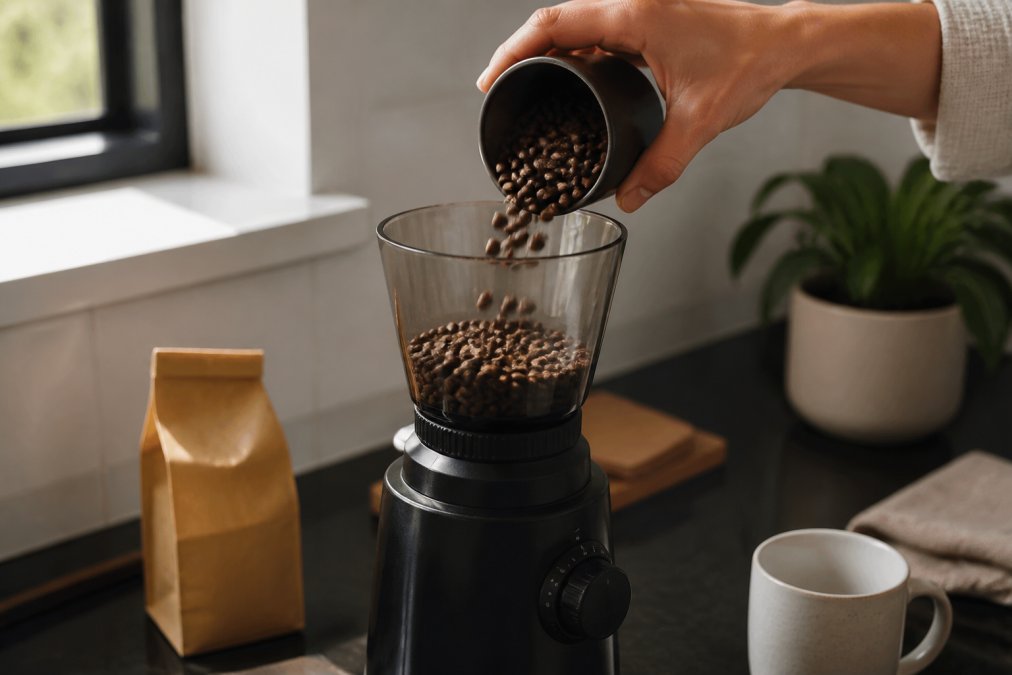
Blade vs Burr Grinder for Home Coffee: The Core Differences
A blade grinder chops coffee with a spinning metal propeller, while a burr grinder crushes beans between two abrasive surfaces set a fixed distance apart (Moccamaster USA | Moccamaster KM5 Burr Grinder). That mechanical difference determines everything downstream: particle size distribution, heat friction, and how repeatable your results are.
How Blade Grinders Chop and Why It Matters
Blade grinders work like a blender. Beans bounce around a chamber while a blade slices whatever it catches. The result is a wide spread of particle sizes, from fine dust to coarse boulders, all in one batch. You also can't control the outcome precisely. Two pulses of the same duration rarely produce the same grind.
Heat is the second problem. The blade spins fast and generates friction, and that heat can start degrading delicate aromatics before you ever brew. For drip coffee with a forgiving brewer, a blade grinder can get you a drinkable cup. For pour over or espresso, it's a losing battle.
How Burr Grinders Crush for Uniformity
Burr grinders feed beans between two burrs and crush them to a set gap width. Because the gap is fixed, every particle exits at roughly the same size. You get uniformity, repeatability, and a grind setting you can return to tomorrow.
The practical payoff is dialing in. When you change one variable, grind size, you can taste the difference and adjust with confidence. With a blade grinder, you're changing several variables at once every time you press the button.
How Grind Size Affects Coffee Extraction
Grind size determines how fast water pulls flavor from coffee grounds. Smaller particles have more surface area and extract faster; larger particles extract slower. If your grind is too fine, water over-extracts and you get bitterness and a drying, astringent finish (Effect of grinding, extraction time and type of coffee on the physicochemical and flavour...). Too coarse, and water under-extracts, leaving a sour, thin, hollow cup. This is the single most useful lever you own as a home brewer, because changing the grind changes extraction rate, flavor profile, and body without touching your recipe, your water, or your technique.
The mechanism is worth understanding because it explains why grind beats almost every other variable. Extraction is a diffusion process: hot water dissolves soluble compounds, acids, sugars, lipids, and bitter alkaloids, off the surface of each particle and then out of its interior. A fine particle exposes more surface area per gram, so the fast-releasing compounds (fruit acids and sugars) come off quickly and the slower, heavier compounds (bitterness and astringency) follow soon after. A coarse particle releases the same compounds, just more slowly. Your brew time and water temperature set the window; your grind size decides whether the coffee finishes extracting inside that window or gets cut off partway.
Fines, Boulders, and the Flavor They Create
Fines are the powdery particles that slip through a grinder and extract almost instantly, contributing bitterness and astringency. Boulders are oversized chunks that barely extract at all, leaving sourness and a hollow finish. A good burr grinder minimizes both. A blade grinder produces both in every batch, which is why the same beans can taste harsh and weak at the same time, you are literally tasting over-extracted fines and under-extracted boulders in the same sip.
Particle size distribution, not average particle size, is what separates a good grinder from a great one. Two grinders can both target a medium setting and still produce very different cups if one throws a wide spread of fines and boulders and the other keeps 80 percent of particles inside a narrow band. This is why burr geometry, burr size, and burr sharpness matter as much as the number on the dial.
Dialing In by Brew Method: Drip, French Press, Pour Over
Each brewing method wants a different grind, and a burr grinder lets you hit it repeatably. Use this as a starting point, then adjust by taste:
| Brew Method | Starting Grind | Adjust If... | Typical Steep/Brew Time |
|---|---|---|---|
| Drip coffee | Medium | Bitter → coarser; sour → finer | 4-5 minutes |
| French press | Coarse | Sludgy → coarser; weak → finer | 4 minutes |
| Pour over | Medium-fine | Slow drain → coarser; fast → finer | 2.5-3.5 minutes |
| Espresso | Fine | Gushing → finer; choking → coarser | 25-30 seconds |
A few method-specific notes that most guides skip:
- French press is the most forgiving method because full immersion and a metal mesh filter tolerate a wider particle spread. That is also why it hides a mediocre grinder better than any other method, if you only brew French press, a burr grinder is a smaller upgrade than the marketing suggests.
- Pour over is the least forgiving. A cone brewer with a paper filter punishes fines with a stalled, bitter drawdown and punishes boulders with a fast, sour cup. This is where a burr grinder earns its price fastest.
- Drip sits in the middle. A flat-bed basket and a paper filter smooth out moderate inconsistency, so a mid-range burr grinder is usually enough.
- Espresso demands the tightest distribution and the finest adjustment. Stepped grinders often cannot move in small enough increments, which is why espresso drinkers gravitate toward stepless adjustment.
Reading the Cup: A Troubleshooting Shortcut
When a cup misses, the flavor tells you which direction to move:
- Sour, sharp, salty, or thin → under-extracted → grind finer or extend brew time.
- Bitter, dry, ashy, or hollow → over-extracted → grind coarser or shorten brew time.
- Both sour and bitter in the same cup → uneven particle distribution → the grinder, not the recipe, is the problem.
- Good flavor but weak body → likely a ratio or dose issue, not grind.
That third line is the one that answers the keyword question directly. When a cup tastes simultaneously sour and bitter, no recipe tweak fixes it, because the problem is the spread of particle sizes. A burr grinder is the fix. A blade grinder cannot be dialed out of that failure mode.
Conical vs Flat Burrs: Which Geometry Suits Your Brew
Conical burrs use a cone-shaped inner burr spinning inside a ring burr, while flat burrs use two parallel discs facing each other. Both crush beans uniformly, but they produce slightly different particle distributions and carry different price and maintenance profiles.
Conical burrs are the common choice for home brewing. They're quieter, more forgiving of imperfect alignment, and typically cheaper to manufacture. Flat burrs, common in commercial settings, tend to produce a narrower particle distribution that some brewers prefer for clarity in pour over and espresso. The tradeoff is cost, noise, and a steeper alignment requirement.
For most home setups, a quality conical burr grinder delivers everything you need. Flat burrs matter more when you're chasing the last few percent of cup clarity and you're willing to pay for it.
What Most Reviews Skip: Noise, Retention, and Repairability
Spec sheets rarely mention the three things that shape daily ownership: how loud the grinder is, how much coffee it wastes, and whether you can fix it when something wears out. These are the details that decide whether a grinder feels like a tool or a chore, and they are the ones most reviews skip entirely. Here is how to evaluate each before you buy.
Noise Levels in a Small Kitchen
Burr grinders run quieter than blade grinders because they spin slower and crush rather than chop. In a small kitchen, that difference matters at 6 a.m. A blade grinder's high-pitched whine carries through walls and wakes up the household. A burr grinder produces a lower, shorter sound, and hand grinders are nearly silent, which is why they appeal to early risers and apartment dwellers.
The practical range to expect: a typical electric burr grinder runs in the range of a normal conversation to a blender, while a blade grinder sits closer to a blender at full speed. Hand grinders produce only the sound of beans cracking, which is roughly the volume of rustling paper. If noise is your deciding factor, a hand grinder solves it completely, at the cost of 30 to 60 seconds of cranking per dose and a practical limit on how fine you can grind for espresso.
A few noise-reduction tactics that actually work:
- Grind before bed, not at 6 a.m. Ground coffee stales faster than whole beans, but a sealed container in a cool cabinet buys you several hours with minimal loss.
- Set the grinder on a rubber mat or folded towel. Vibration transfer to the countertop is a large share of perceived noise.
- Choose a slower-RPM model. Lower burr speed means less motor whine and less heat, though it also means longer grind times.
Retention, Static, and Waste
Retention is the coffee that stays inside the grinder after you finish grinding. Every gram retained is a gram that goes stale in the chute and ends up in your next cup. Static makes it worse, clinging fines to the burr chamber and exit chute.
Retention matters most for two reasons. First, stale grounds contaminate the next dose, if you retain a gram and dose 18 grams, roughly 5 percent of your next cup is yesterday's coffee. Second, retention is a hidden cost. A grinder that retains a gram per dose wastes a gram per dose, which adds up across hundreds of mornings.
Lower retention means fresher coffee and less waste. Single-dose grinders, which you fill with exactly the beans you need, keep retention minimal. If you grind a large hopper at once, expect more stale grounds to accumulate over time. Anti-static coatings, bellows-style purge mechanisms, and vertical or near-vertical chute designs all reduce retention. If a manufacturer publishes a retention figure, treat it as a best-case number measured with a clean grinder; real-world retention is usually higher.
Spare Parts and Long-Term Durability
A burr grinder is a repairable machine, and that changes the math on the "worth it" question. Burrs wear out and can be replaced. Motors, switches, and hoppers are often available as parts. A blade grinder is typically disposable; when the motor dies, you replace the whole unit.
Before buying, check three things:
- Does the manufacturer sell replacement burrs? If not, the grinder has a fixed lifespan.
- How are the burrs removed? Tool-free or single-tool designs are far easier to service than models requiring disassembly of the entire housing.
- Is the burr set rated for a lifespan? Manufacturers that publish a burr-life rating are signaling that replacement is part of the design, not an afterthought.
A grinder you can service can last years, which spreads the cost across hundreds of mornings. That is the real answer to whether a burr grinder is worth it: the upfront price is not the price. The price is the upfront cost minus the resale or service life, divided by the number of cups it produces. A repairable grinder with replaceable burrs wins that math against a disposable blade grinder almost every time, provided you actually replace the burrs when they dull.
Best Entry Level Burr Grinders for Specialty Coffee
Entry-level burr grinders have improved dramatically, and you no longer need to spend a fortune to get uniform grinds. The best entry level burr grinders for specialty coffee share three traits: adjustable burrs, low retention, and parts you can replace.
When you're evaluating options, weigh these factors:
- Burr type and size: Larger burrs grind faster and more consistently, but cost more.
- Adjustment mechanism: Stepped grinders click into set positions; stepless grinders offer infinite adjustment for espresso.
- Motor torque: Higher torque handles light roasts without stalling.
- Retention and static control: Look for anti-static coatings or single-dose designs.
- Repairability: Confirm replacement burrs are sold separately.
Is a Burr Grinder Worth It for Your Home Brewing Setup?
A burr grinder is worth it if you drink coffee regularly, brew with any method that rewards consistency, and want repeatable results. The upgrade pays off fastest for pour over, French press, and espresso drinkers, where uneven grinds are most obvious in the cup.
Skip it if you only drink pre-ground coffee, brew occasionally, or genuinely can't taste the difference and don't want to. There's no shame in that. But if you've ever had a cup that tasted flat and bitter at the same time, uneven grind is the likely culprit.
Here's the honest math. You'll spend more upfront on a burr grinder than on a blade grinder. In return, you get years of service, replaceable parts, and control over one of the two variables that matter most in brewing. The beans are the other one.
Pairing Your Grind with Single-Origin Beans
Single-origin beans reward a good grinder more than blends do, because their flavor profiles are more delicate and more sensitive to extraction. A bright, fruit-forward bean can turn muddy with an uneven grind; a chocolatey, nutty bean can turn bitter.
At Venro Coffee Co., we roast single origins specifically to preserve their origin character, which means the grinder is doing real work in the cup.
Frequently Asked Questions
What is the main difference between a blade and a burr grinder?
A blade grinder uses a spinning metal blade to chop beans into random sizes, creating a mix of fine dust and coarse chunks. A burr grinder passes beans between two abrasive surfaces set at a fixed distance, producing a uniform grind. That consistency is why a burr grinder is worth it for home brewing: even extraction depends on all particles releasing flavor at the same rate. Blade grinders are cheaper, but the uneven result often leaves your cup both bitter and sour at once.
Does a burr grinder really make coffee taste better?
Yes, because grind consistency controls extraction. When particles are uniform, water extracts flavor evenly, giving you a balanced cup with clear sweetness and acidity. A blade grinder produces fines that over-extract and boulders that under-extract, so you taste both bitterness and sourness. For drip coffee, French press, or pour over, the improvement from a burr grinder is one of the most noticeable upgrades you can make. The difference is especially clear with light-roasted single origins like a Kenya or Tanzania.
How does grind consistency affect coffee extraction?
Grind consistency determines how evenly water can pull flavor from coffee grounds. Uniform particles expose similar surface area, so extraction happens at one rate. If you have a mix of fine and coarse particles, the fines over-extract and release bitter compounds while the boulders under-extract and leave sour, weak notes. The result is a cup that tastes muddy or hollow. A burr grinder solves this by producing a narrow particle size distribution, which is why it matters for any brewing method.
Is a manual burr grinder worth the effort for home brewing?
For small doses, yes. Manual burr grinders cost less than electric models and often use the same conical burr design, so they deliver consistent grinds for drip, pour over, or French press. The trade-off is time and effort: grinding 30 grams for a full pot can take a few minutes of cranking. If you brew multiple cups daily or want espresso-level fineness, an electric burr grinder is more practical. For one or two cups, a manual burr grinder is a solid entry point.
Do I need a burr grinder for a French press or drip coffee maker?
You do not strictly need one, but a burr grinder makes a bigger difference than most people expect. French press relies on a coarse, even grind to avoid sludge and over-extraction. Drip coffee makers perform best with a medium grind that allows steady water flow. A blade grinder's inconsistent particles will clog filters or slip through the mesh, leading to bitter or weak coffee. If you already own a drip machine or French press, a burr grinder is worth it for the flavor upgrade alone.
The real challenge with home brewing isn't choosing a grinder. It's keeping the beans as fresh as the grind. Venro Coffee Co. delivers freshly roasted specialty coffee directly to your door, with single origins like Mexico, Peru, and Kenya, convenient single-serve capsule options, and a rotating selection of carefully sourced beans that pair with any brew method. Get started with Venro Coffee Co. and taste what a consistent grind and fresh beans actually do for your morning cup.