



How to Brew Specialty Coffee Daily: A Step-by-Step Guide
Table of Contents
- Why Specialty Coffee Requires a Different Brewing Approach
- Best Coffee Brewing Methods for Beginners
- The Role of a Burr Grinder in Specialty Coffee
- Specialty Coffee Golden Ratio: Getting Your Brew Proportions Right
- Water Quality and Temperature for Extraction
- Specialty Coffee Equipment Essentials for Daily Brewing
- How to Store Specialty Coffee Beans for Freshness
- Your Daily Specialty Coffee Workflow: Morning Routine Optimization
- Common Brewing Mistakes to Avoid
- Conclusion
Last Updated: August 7, 2026
Why Specialty Coffee Requires a Different Brewing Approach
Brewing specialty coffee daily isn't just about following a recipe, it's about understanding the science behind extraction and adjusting for variables that mass-market coffee shops ignore. Specialty grade beans demand precision because they're sourced and roasted to highlight specific flavor profiles, acidity, and body characteristics that only emerge when you get the fundamentals right.
The difference between mediocre and exceptional coffee comes down to consistency. When you're working with premium single-origin or carefully curated blend options, small changes in grind size, water temperature, or brew time shift the entire cup profile. This is why specialty coffee enthusiasts invest in burr grinders, scales, and filtered water, not for show, but because these tools directly impact the extraction process.

At Venro Coffee Co., we've worked with home baristas who discovered that specialty coffee brewing requires a different mental model than convenience brewing. You're not just adding hot water to grounds and hoping for the best. You're managing variables to pull out the specific characteristics that make specialty beans worth the investment in the first place.
Best Coffee Brewing Methods for Beginners
The best brewing method for specialty coffee depends on your lifestyle, available equipment, and how much control you want over the brewing process. Pour over and immersion brewing are the two foundational approaches, each offers different advantages and learning curves.
Pour Over Brewing
Pour over brewing gives you direct control over every variable: water temperature, pour rate, grind size, and bloom duration. This method extracts coffee through filtered water flowing over grounds, which produces a clean cup with bright acidity and defined flavor notes.
The process is straightforward. You place a paper or metal filter in a dripper, add medium-fine grounds, pour hot water in stages, and let gravity do the work. The filter removes oils and fine particles, which is why pour over tends to highlight the delicate, nuanced flavors in specialty beans.
Pour over works best for single-origin coffees where you want to taste the grower's specific terroir, the environmental characteristics that shape the bean's flavor profile. The method is forgiving for beginners because you can adjust your pour speed and water temperature on the fly if your first attempt tastes off.
Common pour over devices include the Chemex, Hario V60, Kalita Wave, and Melitta dripper. Each has slightly different design features that affect water flow and extraction, but the fundamental principle remains the same: controlled water contact with grounds over time.
Immersion Brewing
Immersion brewing works by steeping grounds directly in hot water for a set time, then separating the liquid from the solids. The most common immersion method is the French press, though cold brew and cupping also use this approach.
With immersion brewing, all the grounds contact water simultaneously for the entire steep time, which produces a fuller body and heavier mouthfeel compared to pour over. This method highlights the coffee's body and sweetness rather than its acidity and brightness.
Immersion brewing is less forgiving than pour over because you can't adjust extraction mid-brew, once you start steeping, the process is locked in. However, it's also more intuitive for beginners. You don't need to master a pouring technique. You simply add grounds, add water, wait, and press.
The trade-off is that immersion methods produce slightly more sediment and oils in your cup, which some people prefer and others find too heavy for daily drinking. If you like a full-bodied, rich cup with pronounced sweetness, immersion is your method.
The Role of a Burr Grinder in Specialty Coffee
A burr grinder is non-negotiable for specialty coffee brewing. It's the single most important piece of equipment after your brewing device itself, and here's why: grind size directly determines extraction.
When you grind coffee, you're increasing surface area so water can dissolve the soluble compounds inside the bean. If your grind is too coarse, water passes through too quickly and under-extracts, your coffee tastes sour and thin. If your grind is too fine, water moves too slowly and over-extracts, your coffee tastes bitter and astringent. The sweet spot is a consistent, properly-sized grind that matches your brewing method.
Burr grinders come in two types: blade grinders and burr grinders. Blade grinders chop beans unevenly, producing a mix of particle sizes that brew inconsistently. Burr grinders use two rotating surfaces (burrs) to crush beans to a uniform size. This consistency is essential for specialty coffee because it ensures even extraction across all the grounds.
A quality burr grinder lets you dial in your grind size precisely. For pour over, you typically want medium-fine grounds. For immersion brewing, you want medium-coarse. For espresso, you need fine. A good grinder has adjustment settings that let you move between these profiles without guessing.
Specialty Coffee Golden Ratio: Getting Your Brew Proportions Right
The specialty coffee golden ratio is 1:16, one part coffee to sixteen parts water by weight. This ratio produces a balanced cup for most brewing methods and is the starting point for dialing in your perfect brew.
Why weight instead of volume? Coffee beans vary in density depending on roast level and origin. A scoop of light-roasted beans weighs differently than a scoop of dark-roasted beans, which throws off your brew ratio if you measure by volume. A digital scale removes this variable and gives you reproducible results every time.
To use the golden ratio, weigh your dry grounds, multiply by 16, and that's your target water weight in grams. If you're brewing 20 grams of coffee, you want 320 grams of water. If you're brewing 30 grams, you want 480 grams of water.
This ratio is a baseline, not gospel. Different brewing methods and coffee origins benefit from slight adjustments. Pour over often works best at 1:17 or 1:18 for brighter extraction. French press often prefers 1:14 or 1:15 for fuller body. The specialty coffee golden ratio gives you a reliable starting point, then you adjust based on your taste preferences and what you're tasting in the cup.
Many home baristas make the mistake of eyeballing their brew ratio. They use "about a tablespoon per cup" or some other rough estimate, then wonder why their coffee tastes inconsistent day to day. A simple digital scale costs under $15 and eliminates this guesswork entirely.
Water Quality and Temperature for Extraction
Water makes up 98% of your brewed coffee, yet most people pay zero attention to it. The quality and temperature of your water directly impact extraction, flavor, and consistency.
Tap water often contains chlorine, minerals, and other compounds that interfere with coffee's flavor. Filtered water removes these contaminants and produces a cleaner-tasting cup. If your tap water is particularly hard or mineral-heavy, a simple pitcher filter or faucet filter makes a noticeable difference.
Water temperature controls extraction speed. Higher temperatures extract faster and pull out more compounds, including bitter ones. Lower temperatures extract slower and produce a lighter, brighter cup. For most specialty coffee brewing, the ideal water temperature is between 195°F and 205°F, just off boiling.
If you're using a standard electric kettle, you can't control the temperature precisely. A gooseneck kettle with a built-in thermometer lets you dial in the exact temperature your coffee needs. This is especially useful when dialing in a new coffee or brewing method.
Total dissolved solids (TDS) is a measure of how many minerals are in your water. Water with too few minerals under-extracts and tastes flat. Water with too many minerals over-extracts and tastes harsh. Specialty coffee enthusiasts often use filtered water or bottled water with a TDS in the 150-250 ppm range, which provides enough mineral content for balanced extraction without harshness.
The practical takeaway: use filtered water, heat it to 195-205°F, and you've solved 80% of extraction problems. Everything else is refinement.
Specialty Coffee Equipment Essentials for Daily Brewing
You don't need an expensive espresso machine or a cabinet full of gadgets to brew excellent specialty coffee daily. A focused set of essential equipment gets you 95% of the way there.
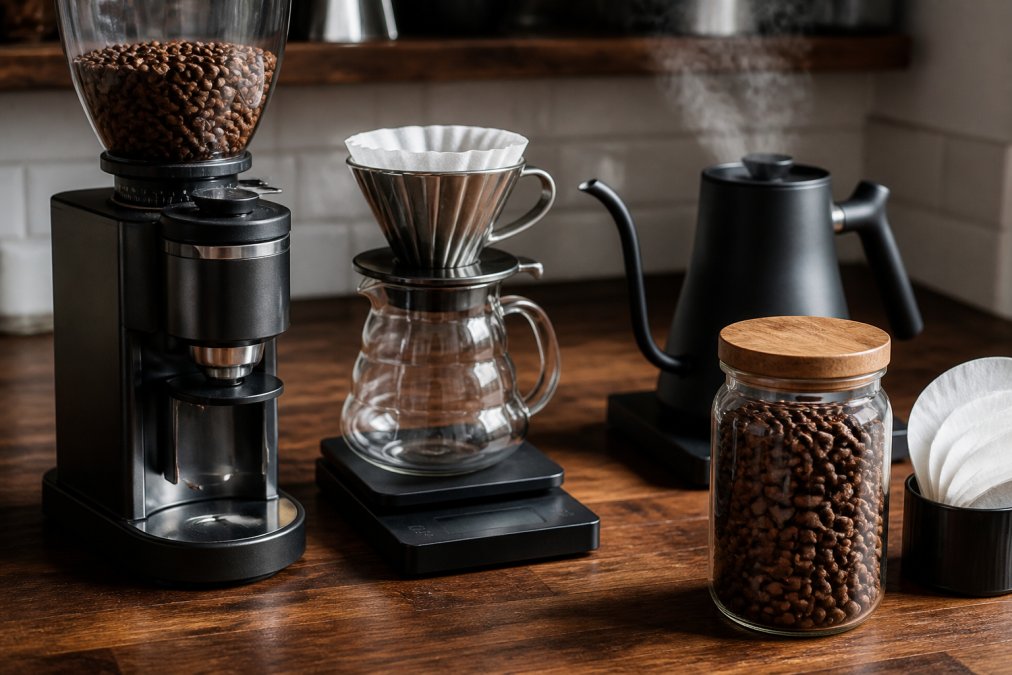
The core essentials:
- Burr grinder, Non-negotiable. Consistency in grind size determines extraction consistency.
- Brewing device, Choose one: pour over dripper, French press, Aeropress, or Moka pot. Start with pour over for simplicity.
- Digital scale, Enables the golden ratio and reproducible brewing. Essential for dialing in.
- Gooseneck kettle, Gives you precise pouring control and temperature visibility. A standard kettle works, but a gooseneck improves consistency.
- Filtered water, Either a pitcher filter, faucet filter, or bottled water. Removes chlorine and mineral imbalances.
- Timer, Your phone works fine. Tracks brew time so you can reproduce good results.
That's it. These five items cost under $150 total and enable you to brew specialty coffee that rivals most coffee shops.
Everything else, timers with Bluetooth, temperature-controlled kettles, pour-over scales, specialty filters, is optimization for people who've already mastered the fundamentals. Start with the essentials, brew consistently for two weeks, then add tools only if you've identified a specific problem they solve.
Venro Coffee Co. offers convenient single-serve capsule options if you need maximum simplicity on busy mornings, but they work best as a backup, not a replacement for learning to brew specialty coffee properly. The capsules deliver quality coffee quickly, but you miss the control and learning that comes with manual brewing.

How to Store Specialty Coffee Beans for Freshness
Specialty coffee beans are at their peak flavor 2-4 weeks after roasting. After that, they gradually lose their brightness and complexity. Proper storage slows this degradation and keeps your beans tasting fresh longer.
The enemies of coffee freshness are air, light, heat, and moisture. Oxygen causes oxidation, which dulls flavor. Light breaks down compounds that create flavor and aroma. Heat accelerates chemical degradation. Moisture can cause mold and off-flavors.
Store your beans in an airtight container away from direct sunlight and heat. A dark cupboard or pantry is ideal, not the refrigerator or freezer, despite what you might hear. Cold storage causes condensation when you open the container, which introduces moisture and damages the beans.
Buy whole beans in quantities you'll use within 3-4 weeks. Grinding exposes more surface area to oxygen, so grind immediately before brewing rather than storing pre-ground coffee. Pre-ground coffee loses its flavor profile within days.
Check your roast date when you buy. Venro Coffee Co. and other specialty roasters print the roast date on the bag so you know exactly how fresh your beans are. Beans roasted 1-2 weeks ago are ideal for most brewing methods. Beans roasted more than 8 weeks ago have begun to fade noticeably.
If you buy in bulk or want to extend freshness beyond a month, freezing whole beans in an airtight container works well. Thaw them at room temperature before opening the container to prevent condensation. Frozen beans stay fresh for 3-4 months.
Your Daily Specialty Coffee Workflow: Morning Routine Optimization
Most people who struggle with consistency are trying to dial in too many variables at once. The solution is a repeatable workflow that you can execute the same way every morning, even when you're half-asleep.
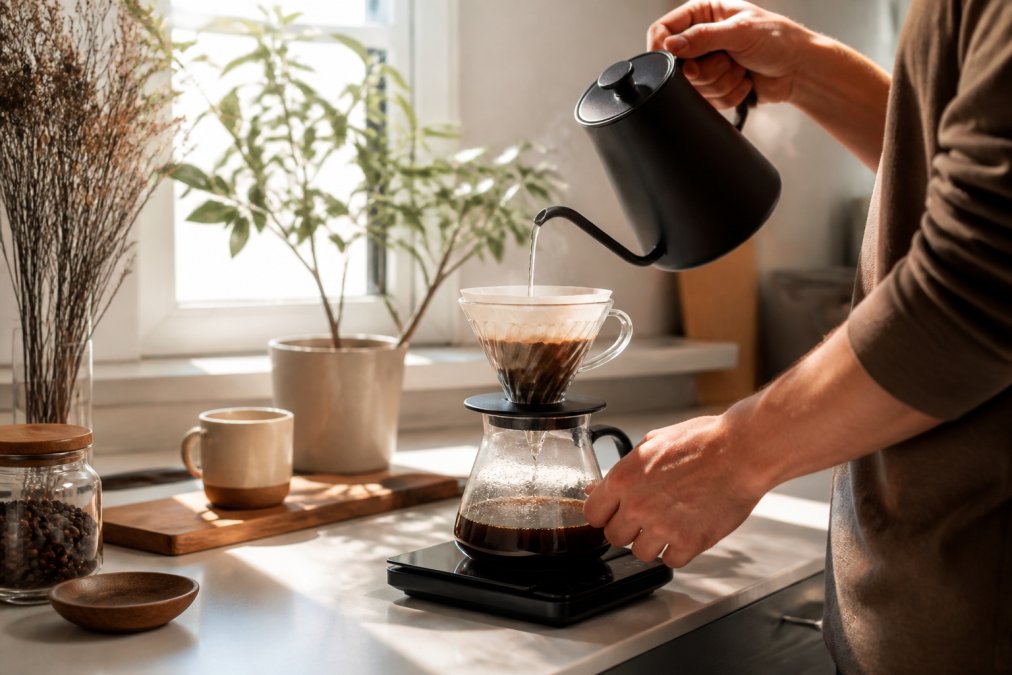
The optimized morning workflow:
-
Measure your beans (1 minute), Weigh 20-30 grams of whole beans depending on your brewing device and how strong you like your coffee.
-
Grind immediately before brewing (2 minutes), Grind to the appropriate size for your method. For pour over, aim for medium-fine. Write down the grind setting so you can reproduce it tomorrow.
-
Heat your water (3-5 minutes), Fill your kettle and heat to 195-205°F. While it heats, prepare your brewing device.
-
Bloom your grounds (45 seconds), Pour just enough hot water to saturate the grounds, then wait. This releases CO2 and prepares the grounds for extraction.
-
Complete your brew (2-4 minutes), Pour the remaining water in stages if you're doing pour over, or complete your immersion steep if you're using French press. Watch your timer.
-
Taste and adjust (1 minute), Drink your coffee and note what you're tasting. If it tastes sour, your next brew needs slightly finer grounds or hotter water. If it tastes bitter, go coarser or cooler.
This entire process takes 8-15 minutes depending on your method. The key is consistency, use the same beans, same grind setting, same water temperature, and same brew time for at least three days before making changes. This lets you identify what actually improved your cup versus random variation.
Many people jump between different beans, grind settings, and brew times every single morning, then complain that their coffee is inconsistent. You can't learn what works if you're changing everything. Pick one specialty coffee, one brewing method, and one grind setting, then brew the same way for a week. Only then should you adjust a single variable.
Common Brewing Mistakes to Avoid
Understanding what goes wrong helps you recognize problems in your own brewing and fix them quickly.
Under-extraction (sour, thin, weak taste): Your grounds contact water too briefly or at too-low temperature. Fix this by using finer grounds, hotter water, or longer brew time. If you're using pour over, slow your pour rate so water stays in contact with grounds longer.
Over-extraction (bitter, astringent, harsh taste): Your grounds contact water too long or at too-high temperature. Fix this by using coarser grounds, cooler water, or shorter brew time. If you're using pour over, increase your pour rate so water moves through faster.
Inconsistent grind size: Your grinder is producing a mix of fine powder and large chunks. This creates uneven extraction where some grounds are over-extracted and others are under-extracted. Only fix is to upgrade to a quality burr grinder.
Stale beans: Coffee more than 8 weeks off the roast date has lost its brightness and complexity. Buy fresher beans or check your roast date before brewing.
Wrong brew ratio: You're eyeballing your measurements instead of using a scale. This makes it impossible to reproduce good results. Invest in a simple digital scale.
Poor water quality: Tap water with high chlorine or mineral content interferes with flavor. Use filtered water or check your water's total dissolved solids.
Temperature inconsistency: You're using a standard kettle that can't hold a precise temperature, or you're letting your water cool too long before brewing. Use a gooseneck kettle with a thermometer or brew immediately after heating.
The good news: most of these mistakes are fixable with one small change. You don't need to overhaul your entire setup. Identify which variable is off, adjust it, and taste the difference.
| Common Issue | Root Cause | Solution | Expected Result |
|---|---|---|---|
| Sour, thin taste | Under-extraction | Finer grounds, hotter water, longer brew time | Balanced, clean cup |
| Bitter, harsh taste | Over-extraction | Coarser grounds, cooler water, shorter brew time | Smooth, sweet finish |
| Inconsistent results | Uneven grind size | Upgrade to burr grinder | Reproducible, predictable cups |
| Flat, dull flavor | Stale beans | Buy fresher beans (check roast date) | Bright, complex cup |
| Unmeasurable adjustments | Eyeballing measurements | Use digital scale for all weights | Repeatable brewing |
Brewing specialty coffee daily is about building a repeatable system where you control the variables that matter most: grind size, water temperature, brew ratio, and brew time. Once you've mastered these fundamentals, you can taste the specific characteristics that make specialty beans worth seeking out.
The best way to start is with a single specialty coffee from Venro Coffee Co. or another quality roaster, one brewing method, and a commitment to brewing the same way for a full week. This teaches you what consistency feels like and gives you a baseline for understanding how each variable affects your cup. After a week, you'll have the confidence to adjust intentionally rather than guessing. That's when specialty coffee becomes a ritual you actually enjoy instead of a frustrating experiment.
Frequently Asked Questions
What is the golden ratio for brewing specialty coffee?
The specialty coffee golden ratio is 1:16 by weight, one gram of coffee to 16 grams of water. This ratio produces balanced extraction that highlights the flavor profile of specialty beans. For example, 20 grams of coffee with 320 grams of water creates a full cup. Some specialty coffee enthusiasts adjust between 1:15 and 1:17 depending on the origin and roast level, but 1:16 is the industry standard starting point.
Why is a burr grinder essential for specialty coffee?
A burr grinder produces uniform particle size, which is critical for consistent extraction. Blade grinders create uneven chunks and fines, leading to over-extraction and bitter flavors. Burr grinders, whether flat or conical, allow you to dial in precise grind sizes (medium-fine for pour over, medium-coarse for immersion) that match your brewing method, directly affecting the taste and body of your cup.
How do I know when specialty coffee beans are still fresh?
Specialty coffee beans peak in flavor 5-30 days after roasting. Check the roast date on the bag, this is more important than the expiration date. Fresh beans produce a visible bloom (CO2 release) when first contacted with hot water. Store beans in an airtight container away from light, heat, and moisture. If your beans are more than 4 weeks old, they'll still brew, but the acidity and brightness will fade.
What water temperature should I use to brew specialty coffee?
Optimal water temperature for specialty coffee is 195-205°F (90-96°C). Water that's too hot over-extracts and produces bitter, burnt flavors; water that's too cool under-extracts and tastes sour or thin. If you don't have a thermometer, boil water and wait 30 seconds before brewing. The specific temperature varies slightly by roast level and origin, but this range works for most specialty coffees.
This article was written using GrandRanker