



Coffee Bean Grind Size Guide for Beginners
Table of Contents
- Why Coffee Grind Size Is the Most Important Variable You Control
- Grind Size Chart: Matching Particle Size to Your Brew Method
- The Best Grind Size for French Press (and Why It's Coarser Than You Think)
- How to Dial In Espresso Without Wasting a Bag of Beans
- Troubleshooting Bitter or Sour Coffee: A Grind-First Diagnostic
- How to Adjust Your Grinder Settings Step by Step
- Blade vs. Burr Grinders: What Beginners Actually Need
- Grinder Maintenance and Calibration for Consistent Grinds
- Conclusion
- Frequently Asked Questions
Last Updated: September 19, 2026
Why Coffee Grind Size Is the Most Important Variable You Control
Ask ten home baristas what changed their coffee the most and most will say the same thing: grind size. This coffee bean grind size guide for beginners starts with that single truth because particle size controls how fast water extracts flavor from your grounds, and no other variable you touch at home moves the needle as much. At Venro Coffee Co., we hear from customers every week who upgraded their beans but never touched their grinder settings, then wondered why the cup still tasted flat.
Here's the core mechanism in plain terms. Smaller particles expose more surface area, so water pulls flavor out faster. Larger particles slow that process down. Get the grind wrong and even excellent beans taste bitter, sour, or watery.
The Specialty Coffee Association's brewing guidance treats grind as one of the primary controls for extraction, alongside water temperature, brew ratio, and contact time.
What most guides get wrong is treating grind size as a fixed chart you memorize. It isn't. It's a dial you adjust based on your beans, your equipment, and what's in the cup.
Grind Size Chart: Matching Particle Size to Your Brew Method
Match your grind to your brew method first, then fine-tune from there. Every method below has a starting range, not a fixed answer, because the same setting behaves differently across grinders.
| Brew Method | Grind Size | Texture Reference | Typical Brew Time |
|---|---|---|---|
| Espresso | Fine | Powdered sugar | 25-30 seconds |
| Aeropress | Fine to medium-fine | Table salt | 1-2 minutes |
| Moka pot | Fine to medium | Fine sand | 4-5 minutes |
| Drip coffee | Medium | Beach sand | 4-6 minutes |
| Pour over | Medium to medium-fine | Table salt | 2-4 minutes |
| French press | Coarse | Sea salt | 4 minutes steep |
| Cold brew | Extra coarse | Peppercorns | 12-18 hours |
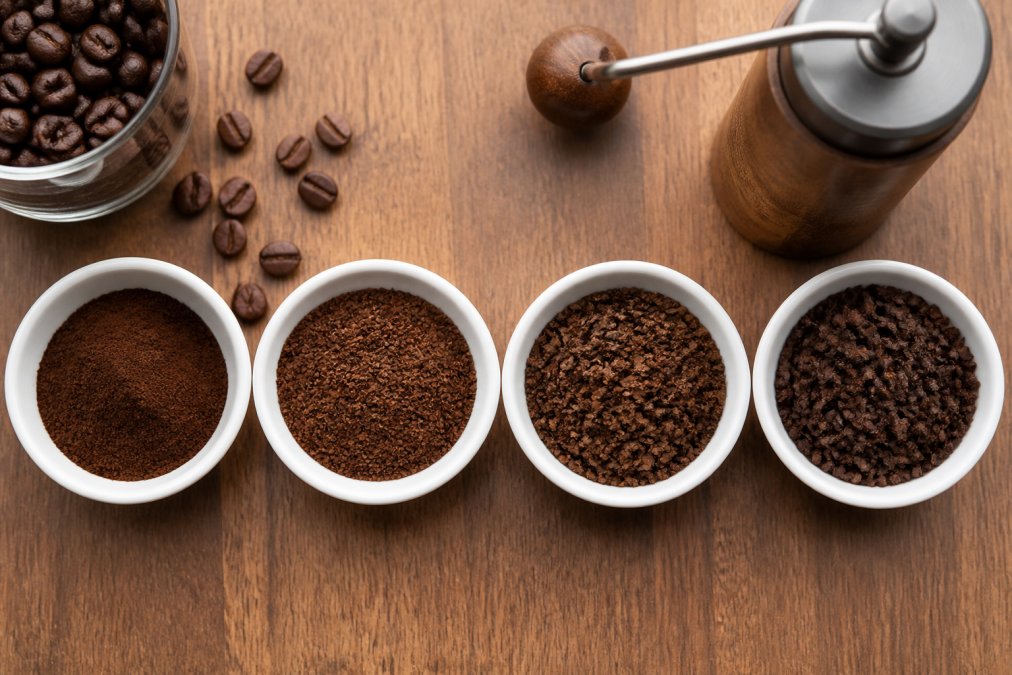
Fine, Medium, and Coarse: What Each Looks and Feels Like
Fine grinds feel like powdered sugar between your fingers and clump slightly when pinched. Medium grinds resemble beach sand and hold a loose shape when squeezed. Coarse grinds feel like sea salt or cracked peppercorns and fall apart immediately when you press them.
If you're unsure where your grinder sits, rub a small pinch between your thumb and index finger. That tactile check beats guessing from a photo.
How Bean Density and Roast Level Change Your Starting Point
Denser beans and lighter roasts need a slightly finer grind than the chart suggests, because they resist extraction. Softer beans and darker roasts extract faster, so you often need to go coarser to avoid bitterness. This is the variable most static charts ignore, and it's why two bags of beans at the same roast level can want different settings.
The Best Grind Size for French Press (and Why It's Coarser Than You Think)
The best grind size for French press is coarse, roughly the texture of sea salt or cracked peppercorns. A full-immersion brewer keeps water in contact with the grounds for four minutes or more, so a fine grind over-extracts and turns bitter fast.
Beginners often grind finer here because they assume finer means stronger. It doesn't. It means harsher. The metal mesh filter also lets fine particles through, so a too-fine grind leaves sludge at the bottom of your cup.
Start coarse, steep for four minutes, then press slowly. If the cup tastes weak, nudge one setting finer on your next batch rather than jumping several steps.
How to Dial In Espresso Without Wasting a Bag of Beans
Dialing in espresso means adjusting your grind until a shot pulls in the target time window with a flavor you actually enjoy. Change one variable at a time, and taste every shot. Chasing perfect numbers before you understand the taste wastes beans.
Work through this sequence:
- Pick a starting point: fine grind, roughly powdered sugar texture
- Pull a shot and time it. Aim for 25-30 seconds from first drip
- If it runs under 25 seconds, the grind is too coarse. Go finer
- If it runs past 30 seconds, the grind is too fine. Go coarser
- Taste. Sour and thin means under-extracted, so go finer
- Bitter and dry means over-extracted, so go coarser
- Adjust in small single steps and re-taste after each change
Keep your dose and water volume constant while you dial in. If you change grind and dose together, you won't know which one fixed the shot.
A common mistake is adjusting the grind by several clicks at once. One step at a time, or you'll overshoot and start guessing.
Troubleshooting Bitter or Sour Coffee: A Grind-First Diagnostic
Troubleshooting bitter or sour coffee starts with one question: did the shot or brew run too long or too short? Bitterness points to over-extraction, which usually means your grind is too fine for the method. Sourness points to under-extraction, which usually means it's too coarse.
Use this diagnostic before you blame your beans:
| Taste Problem | Likely Cause | Grind Fix | Other Check |
|---|---|---|---|
| Bitter, dry, harsh | Over-extracted | Go coarser | Lower water temp slightly |
| Sour, sharp, thin | Under-extracted | Go finer | Raise water temp slightly |
| Weak but not sour | Too coarse or too little coffee | Go finer | Increase brew ratio |
| Muddy, sediment-heavy | Too many fines | Go coarser | Check grinder burrs |
| Inconsistent cup to cup | Uneven particle size | Replace blade grinder | Clean burrs |
Water temperature interacts with grind here. Hotter water extracts faster, so a brew that turns bitter at high heat may taste balanced a few degrees cooler. Adjust grind first, then temperature.
How to Adjust Your Grinder Settings Step by Step
Adjust your grinder one notch at a time and brew a small test batch after each change. That's the short version. The longer version is about understanding what your grinder is actually doing when you turn the dial, because the number on the collar is a reference point, not a universal measurement.
On most burr grinders, one "click" or "notch" moves the burrs a fixed distance apart. On a stepped grinder, you get discrete positions. On a stepless grinder, you get infinite adjustment within a range. Neither is inherently better for beginners, stepped grinders are easier to return to a known setting, while stepless grinders let you make micro-adjustments that stepped models can't reach. Know which one you own before you start chasing a setting.
Here's the sequence that works across drip, pour over, French press, and espresso:
- Write down your current setting before you touch anything
- Move exactly one step finer or coarser
- Brew the same recipe with the same dose, water volume, and water temperature
- Time the brew and taste it
- Note whether the cup moved toward or away from balanced
- Repeat until the cup tastes right, then record the setting
- Re-check the setting when you open a new bag of beans
For pour over and drip, flow rate is your primary feedback signal. If your drip coffee finishes too fast, say, a 4-cup batch that normally takes 5 minutes finishes in 3, go finer. If it stalls and drips slowly, go coarser. For French press, you don't have flow rate as a signal because it's full immersion; instead, watch for sediment in the cup and taste for bitterness. For espresso, time from first drip to the end of the shot is your signal, and you're aiming for that 25-30 second window as a starting point, not a rule.
The mistake that wastes the most beans is adjusting by several clicks at once. If you jump from a 12 to an 8 on a stepped grinder, you've skipped past the setting that might have been perfect and you won't know it. One step, one brew, one taste. That's the whole method.
A second mistake is changing grind and dose at the same time. If you go finer and also add half a gram of coffee, you won't know which change fixed the shot. Lock your dose first, then adjust grind. Once the grind is right, you can fine-tune dose for strength without confusing the two variables.
Reading Your Grinder's Feedback Beyond the Number
Your grinder's number is only meaningful relative to its own zero point. If you deep-clean the burrs and reassemble without recalibrating, your "8" today may grind coarser or finer than your "8" did last month. That's why calibration matters more than memorizing numbers. Re-zero your grinder after every deep clean so the numbers stay comparable over time.
A common pattern is that beginners blame the beans when the grind is wrong. If a coffee tastes flat and you've already tried going finer and coarser without improvement, check your water temperature and brew ratio before you buy new beans. Grind is the biggest lever, but it's not the only one.
Blade vs. Burr Grinders: What Beginners Actually Need
A burr grinder produces consistent particle size, and consistency is what makes grind adjustment predictable. A blade grinder chops beans into a mix of fine dust and coarse chunks, so you can never fully dial in a brew because every batch extracts unevenly.
That unevenness has a name: fines and boulders. Fines are the powdery particles that over-extract and add bitterness. Boulders are the large chunks that under-extract and add sourness. A blade grinder creates both in every batch, which is why the same setting tastes different cup to cup.
If you're serious about the coffee bean grind size guide for beginners approach, a burr grinder is the one upgrade worth making early. Hand burr grinders cost less than electric models and deliver the same consistency for small batches. If you're not ready to buy one, ask your local roaster to grind for your brew method, and buy in smaller amounts so the grounds stay fresh.
What to Do If You Already Own a Blade Grinder
Most beginner guides assume you have a burr grinder. If you don't, you're not stuck, you just have to work within the blade grinder's limits. Here's how to get the most consistent results from the equipment you already own:
- Pulse, don't hold. Run the blade in short 2-3 second bursts and shake the grinder between pulses. This prevents the fine dust from packing at the bottom while the top chunks stay coarse.
- Grind in small batches. Filling the bowl halfway gives the blades room to move beans around. A full bowl means the top layer barely gets touched.
- Sift out the fines. A simple kitchen strainer removes the powdery particles that cause bitterness. It's an extra step, but it makes a noticeable difference in French press and pour over.
- Use a timer. Ten seconds of blade grinding produces a very different result than twenty. Pick a time, stick to it, and adjust in one-second increments.
- Accept the ceiling. A blade grinder will never match a burr grinder for espresso. For French press, cold brew, and drip, you can get a drinkable cup with practice. For espresso, the inconsistency is too punishing.
A common pattern is that beginners upgrade their beans before their grinder and wonder why the cup doesn't improve. If you're buying specialty coffee and grinding it with a blade grinder, the grinder is the bottleneck. A hand burr grinder is the single highest-impact upgrade you can make, and it costs less than two bags of good beans.
When to Ask Your Roaster to Grind for You
If you're not ready to buy a burr grinder and you don't want to fight a blade grinder, ask your local roaster to grind for your brew method. Buy in small amounts, a week's worth at most, because pre-ground coffee stales faster than whole bean. Tell them exactly how you brew: drip, pour over, French press, or espresso. A good roaster will set the grind for your method, and you can adjust your brew ratio and water temperature to compensate for the rest.
The trade-off is real: you lose the ability to dial in grind size yourself, which is the whole point of this guide. But for a beginner who's still learning to taste the difference between under-extracted and over-extracted coffee, pre-ground from a roaster is a better starting point than inconsistent blade-ground coffee at home.
Grinder Maintenance and Calibration for Consistent Grinds
Clean your grinder regularly and recalibrate it after every deep clean, because buildup and drift quietly ruin consistency. Oils from roasted beans coat the burrs over time, and a clogged grinder grinds unevenly no matter what setting you choose.
A simple routine keeps things predictable:
- Brush out the burrs weekly if you grind daily
- Use grinder cleaning tablets monthly for electric burr grinders
- Re-zero your grinder after reassembly so your settings mean something
- Replace burrs when the manufacturer recommends it, as dull burrs crush rather than cut
The thing nobody tells you about calibration is that your "8" today may not be the same as your "8" last month. Re-zeroing after cleaning restores the reference point so your notes stay useful.
Conclusion
Grind size is the lever that turns good beans into a great cup, and it's the one variable beginners can control immediately without buying anything new. Start with the chart, adjust one step at a time, and taste every change. That habit will teach you more than any static guide.
When you want beans worth dialing in, Venro Coffee Co. delivers freshly roasted single origins straight to your door, including our Mexico Single Origin with its chocolate and nutty profile and our Peru Single Origin with salted caramel and citrus notes. Both work beautifully across drip, pour over, and French press, and both give you a clean starting point for learning your grinder.

Get started with Venro Coffee Co. and taste what a properly dialed grind does for specialty coffee at home.
Frequently Asked Questions
What grind size should I use for coffee beans?
It depends entirely on your brew method and contact time. Espresso needs a fine grind, roughly 200-300 microns, because water passes through in 25-30 seconds. Pour over and drip sit in the medium range. French press and cold brew need coarse grounds because the coffee steeps for four minutes or more. Start with the recommended setting for your brewer, then adjust one notch finer or coarser based on taste.
How do I tell if my grind size is correct?
Taste is the fastest test. If your coffee tastes sharp, sour, or thin, the grind is too coarse and water is rushing past the grounds without pulling out enough flavor. If it tastes bitter, dry, or harsh, the grind is too fine and extraction has gone too far. Adjust one step at a time, brew again, and compare. Consistent particle size matters as much as the setting itself, which is why a burr grinder outperforms a blade grinder for this kind of tuning.
What is the best grind size for French press?
French press needs a coarse grind, similar in texture to sea salt or coarse sand. Because the grounds steep fully submerged for about four minutes, finer particles would over-extract and turn the cup bitter and muddy. If your French press coffee tastes silty or harsh, go coarser. If it tastes weak and sour, go one step finer. A medium-coarse setting also works well if you prefer a fuller body.
Does grind size affect caffeine content?
It affects how much caffeine ends up in your cup, not how much is in the bean. A finer grind exposes more surface area, so water extracts caffeine faster. That is why espresso, with its fine grind and short contact time, delivers a concentrated dose, while a coarse French press grind over four minutes extracts a similar amount. Grind size mainly changes flavor, but it does shift extraction speed for caffeine too.