



How to Identify Roast Date Freshness: A Guide
Table of Contents
- Understanding Roast Date vs. Best-By Date
- The Peak Flavor Window After Roast Date
- The Coffee Degassing Process and Why It Matters
- Visual Indicators to Assess Bean Freshness
- Signs of Stale Coffee Beans You Can Detect
- Aroma and Acidity: What Fresh Coffee Should Smell and Taste Like
- Coffee Shelf Life After Roast Date: Storage and Oxidation
- Home Testing Methods for Roast Date Freshness
- How Roast Level Affects Freshness and Flavor Longevity
- Conclusion
Last Updated: August 16, 2026
Understanding Roast Date vs. Best-By Date
The roast date marks when coffee beans were roasted, the moment when green coffee undergoes heat transformation that develops flavor, aroma, and complexity. The best-by date is a manufacturer's estimate of when the coffee will begin noticeably declining in quality, typically 6-12 months after roasting depending on storage conditions and roast level.
The roast date is far more useful for determining actual freshness than the best-by date. A bag roasted three weeks ago is objectively fresher than one roasted four months ago, regardless of what the best-by label claims. When locating the roast date on the package, it should be printed clearly on the front or back. If a bag doesn't show a roast date, that's a red flag. Reputable roasters print the roast date prominently because transparency about freshness is part of their commitment to quality.
The best-by date exists partly for liability and partly for consumer guidance, but it's overly conservative. Most specialty coffee remains excellent well past the printed best-by date if stored properly. What matters is how much time has passed since roasting and how the beans have been stored.
The Peak Flavor Window After Roast Date
Coffee reaches its peak flavor window roughly 5-14 days after the roast date, though this varies depending on roast level and brew method. This window is when the beans have fully degassed and developed their intended flavor profile without yet beginning to oxidize noticeably.
Think of the peak flavor window as a curve: flavor complexity rises sharply in the first two weeks, plateaus during the peak window, then gradually declines over subsequent weeks and months. A bag roasted 20 days ago may still taste excellent, especially if it's a darker roast, which has a longer peak window than light roasts. A bag roasted 60 days ago will typically show signs of flavor flatness and reduced acidity.
Venro Coffee Co. ships freshly roasted beans because arriving within the peak flavor window ensures you experience the coffee as the roaster intended. When specialty coffee reaches your door within 7-10 days of roasting, you're tasting the beans during their optimal flavor expression. The peak flavor window also depends on storage: beans kept in an airtight, opaque container at room temperature maintain their peak window longer than beans exposed to air, light, and heat.
The Coffee Degassing Process and Why It Matters
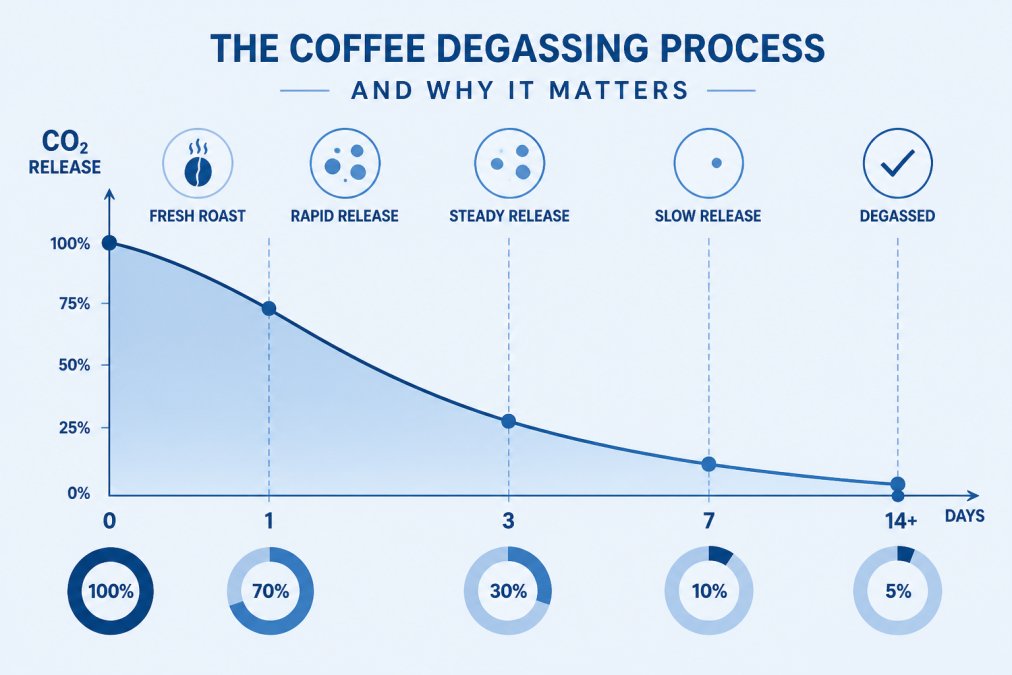
When beans are roasted, heat causes chemical reactions that produce carbon dioxide gas trapped inside the bean structure. This CO2 needs to escape for the coffee to reach its optimal flavor state.
Degassing begins immediately after roasting and continues for several weeks. In the first 24-48 hours, beans release CO2 rapidly, so rapidly that freshly roasted beans can be difficult to brew with espresso machines because the excess gas interferes with water absorption and extraction. By day 5-7, most rapid degassing has completed, though slower degassing continues for weeks afterward. This is why many specialty roasters recommend waiting 5-7 days before brewing espresso, while pour-over brewing can work earlier.
One-way valves on coffee bags allow CO2 to escape without allowing oxygen to enter. A bag that feels soft and slightly puffy is actively degassing, which means it's relatively fresh. A bag that feels hard and compact may be past its peak window. During the degassing phase, some harshness from the roast mellows, and origin characteristics become more pronounced. Brew too early and you get harsh, underdeveloped flavors; brew too late and you get flat, dull notes.
Visual Indicators to Assess Bean Freshness
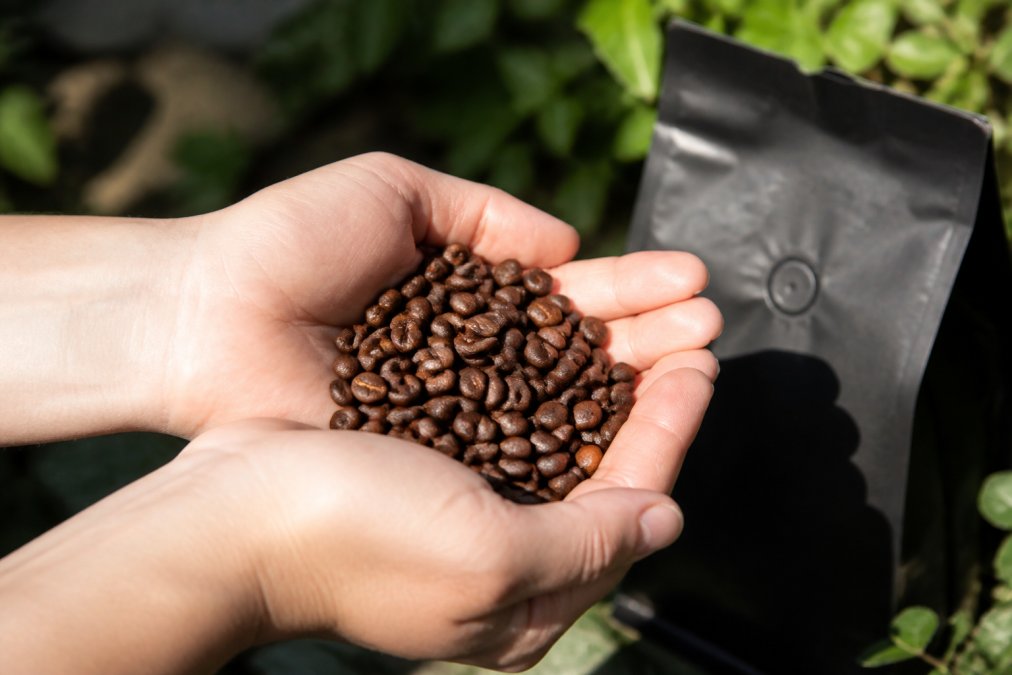
Fresh beans, typically within 2-4 weeks of roast date, display a rich, uniform color appropriate to their roast level: dark chocolatey brown for dark roasts, medium mahogany for medium roasts, and cinnamon to light brown for light roasts. The surface should show a slight sheen or visible oils, especially in darker roasts, indicating the beans haven't begun losing moisture and essential oils to oxidation.
Stale beans appear dull and matte, lacking the visual richness of fresh ones. The color may look faded or grayish, particularly noticeable in dark roasts that should be glossy and deep. This visual dullness reflects actual chemical changes: as beans oxidize, lipids degrade and moisture content drops.
Fresh beans crack and break cleanly when pressed, showing a consistent interior color. Stale beans may appear slightly shriveled or have a papery texture, and they crumble rather than crack. You can test this by examining a few beans from the bag: if they look uniform in color and have that characteristic glossy finish, they're likely within their peak flavor window.
Signs of Stale Coffee Beans You Can Detect
The most obvious sign of stale beans is aroma, or rather, the lack of it. Fresh beans emit a strong, complex aroma when you open the bag; stale beans smell flat, muted, or slightly musty. When you grind stale beans, the aroma issue becomes even more apparent. Fresh ground coffee releases a burst of volatile aromatic compounds; ground stale coffee produces a much weaker aroma because volatile compounds evaporate over time.
Flavor is the ultimate indicator. Stale coffee tastes flat and one-dimensional, lacking the acidity, brightness, and nuance of fresh beans. The sweetness that characterizes fresh coffee fades into a slightly bitter or woody taste. If you brew coffee and it tastes thin, dull, or overly bitter despite using proper technique, the beans are likely stale.
The bag itself provides clues too. If the one-way valve is completely flat and rigid, and the bag feels papery rather than slightly flexible, the beans have finished degassing and oxidation has likely begun. A bag that's been open for weeks will show obvious signs: the beans inside will look duller, and when you pour them out, they may stick together slightly due to residual moisture and oil breakdown.
Aroma and Acidity: What Fresh Coffee Should Smell and Taste Like
Fresh coffee should smell vibrant and complex, with multiple layers when you inhale the aroma from an open bag or freshly ground coffee. A light roast might smell bright and floral; a medium roast might smell balanced with nutty sweetness; a dark roast might smell bold and chocolatey. The key is that fresh beans smell interesting, multiple scent notes rather than a single flat impression.
Acidity in coffee refers to the brightness and liveliness on your palate, the snap that makes the coffee taste alive. Fresh coffee, especially light and medium roasts, should have noticeable acidity that makes your mouth water slightly and adds complexity to the taste. As coffee ages and oxidizes, acidity fades and the coffee tastes duller and less bright. If you brew coffee using proper technique and the result tastes dull and lacks brightness, the beans are old.
Fresh beans smell like their roast level and origin: fruity, floral, nutty, chocolatey, or spicy notes depending on the bean and roast. Aged beans lose these specific notes and develop a generic "old coffee" smell, slightly musty, flat, or even cardboard-like. This deterioration reflects the actual breakdown of volatile aromatic compounds and the beginning of rancidity in the bean oils.
Coffee Shelf Life After Roast Date: Storage and Oxidation
Coffee shelf life after roast date depends almost entirely on storage conditions. Beans stored properly in an airtight, opaque container at room temperature remain in good condition for 4-6 weeks, with peak flavor lasting through week 4. Beans stored in poor conditions, exposed to air, light, heat, or humidity, decline much faster.
Oxidation is the primary enemy of coffee shelf life. When beans are exposed to oxygen, the oils and volatile compounds that create flavor and aroma begin breaking down. This process accelerates with heat and light exposure. A bag left open on a kitchen counter will noticeably degrade within days.
Moisture is the secondary threat. Coffee is hygroscopic, meaning it absorbs moisture from the air. Excess moisture promotes oxidation and can introduce mold risk. The ideal storage environment is cool, dry, and dark, around 50-70°F with humidity between 50-70%.
Temperature fluctuations are particularly damaging. If beans are stored somewhere that experiences temperature swings, the repeated expansion and contraction accelerates oxidation. Consistent, cool storage is far better than warm storage. Once you open the bag, transferring beans to an airtight container immediately extends shelf life significantly.
Home Testing Methods for Roast Date Freshness
The bloom test is the most revealing. Grind a small amount of coffee medium-fine and place it in a filter or pour-over device. Pour just enough hot water (around 200°F) to saturate the grounds, then pause for 30-45 seconds without pouring more water. Fresh coffee will bloom, the grounds will visibly rise and foam as CO2 escapes. Stale coffee will bloom minimally or not at all. A vigorous bloom indicates beans likely within 2-4 weeks of roast date.
The aroma test is simple but effective. Open a bag of beans and inhale deeply. Fresh coffee should smell vibrant and complex with multiple scent layers. If you have to sniff multiple times to detect a smell, or if the aroma is flat and generic, the beans are past their peak. Compare the smell to beans you know are fresh to calibrate your sense.
The grind consistency test requires minimal equipment. Fresh beans produce grounds that are uniform in size and have a slightly oily feel, especially if darker roasted. Stale beans produce grounds that feel drier and may appear slightly grayish rather than rich brown.
The taste test is definitive but requires brewing. Fresh coffee should taste bright, complex, and balanced, with noticeable acidity that makes your mouth water slightly. Stale coffee tastes dull, flat, and one-dimensional, often with a slightly bitter or woody note.
How Roast Level Affects Freshness and Flavor Longevity
Roast level significantly influences how quickly coffee degasses, how long the peak flavor window lasts, and how rapidly beans decline after that window. Light roasts degas more slowly than dark roasts, reaching peak flavor around day 7-10 rather than day 5-7. Light roasts also have a shorter peak window, often just 2-3 weeks before acidity begins fading noticeably.
Medium roasts strike a middle ground. They degas at a moderate pace, reaching peak flavor around day 5-8, and maintain that peak for roughly 3-4 weeks. Medium roasts are often considered the most forgiving for home storage because their peak window is reasonably long and they degrade more gradually than light roasts.
Dark roasts degas quickly and develop their flavor profile within 3-5 days. However, dark roasts have a longer overall shelf life because the roasting process has already broken down many volatile compounds, so there's less to oxidize. A dark roast that's 8 weeks old may still taste acceptable, while a light roast that's 8 weeks old will taste noticeably flat.
Roast level also affects how to identify roast date freshness visually. Dark roasts should be glossy and deep brown; medium roasts should be uniform mahogany; light roasts should be light brown with minimal oil visible. If you prefer light roasts for their bright, complex acidity, you need to use them quickly, within 2-3 weeks of purchase. If you prefer dark roasts, you have more flexibility in timing because the flavor profile persists longer.
Identifying roast date freshness is fundamentally about understanding that coffee is a perishable product with a meaningful peak window, not a shelf-stable commodity. The roast date tells you exactly when that window began. Storage conditions determine how long it lasts. By learning to read visual cues, assess aroma, and understand the degassing process, you can consistently choose coffee at its best. When you order from Venro Coffee Co., you're starting with beans roasted recently and shipped promptly, which means they arrive during their peak flavor window, giving you the freshest possible coffee without guesswork.
Frequently Asked Questions
How long after the roast date is coffee good?
Coffee reaches peak flavor within 5-14 days after roast date and remains excellent for up to 30 days. After 30 days, oxidation and moisture loss accelerate flavor decline. Light roasts maintain acidity longer than dark roasts. Proper storage in an airtight container slows degradation significantly. Beyond 60 days, most specialty coffee loses its intended flavor profile, though it remains drinkable. Brew method matters, espresso extraction shows staleness faster than immersion brewing.
What are the signs of stale coffee beans?
Stale coffee beans show flat or muted aroma, loss of vibrant color (appearing dull or faded), and reduced bloom during brewing. The acidity tastes dull, and flavor notes disappear. Oil migration and visible surface cracks indicate advanced staleness. When ground, stale beans produce weak bloom with minimal foam. Espresso shots pull too fast with thin crema. Taste becomes one-dimensional, lacking the complexity of fresh beans. Visual inspection combined with aroma testing catches staleness before brewing.
Does the roast date indicate when the coffee was packaged?
Roast date and packaging date are not the same. Roast date marks when beans were roasted; packaging typically occurs 24-48 hours later after degassing. Some specialty roasters package immediately with one-way valves to trap carbon dioxide. Check your bag's packaging date if listed separately. One-way valves allow gas escape while blocking oxygen entry, extending freshness. Nitrogen flushing provides additional protection. Always prioritize roast date as the freshness reference point, not packaging date.
How do you store coffee to maintain freshness after opening?
Store opened coffee in an airtight container away from light, heat, and moisture. Keep it at room temperature, not in the refrigerator or freezer, which introduce condensation. Transfer beans to a small opaque container with an airtight seal to minimize air exposure. Oxygen accelerates oxidation and staling. Keep beans in their original bag if it has a one-way valve and you seal it tightly. Whole beans stay fresher longer than ground coffee. Use within 30 days of roast date for optimal flavor and freshness.
This article was written using GrandRanker