



Dark Roast vs Medium Roast Coffee Flavor Profiles
Table of Contents
- Dark Roast vs Medium Roast Coffee Flavor Profiles: The Core Differences
- Acidity in Coffee Roasts: Why Medium Beans Taste Brighter
- Body and Mouthfeel: Syrup vs Silk
- Tasting Notes by Roast Level
- Caffeine Content in Medium vs Dark Roast: The Myth
- Best Brewing Methods for Dark Roast Coffee
- Health Benefits and Antioxidant Variations
- How to Choose the Right Roast for Your Palate
- Frequently Asked Questions
Last Updated: September 11, 2026
Dark Roast vs Medium Roast Coffee Flavor Profiles: The Core Differences
Dark roast vs medium roast coffee flavor profiles come down to one variable: how long the beans stayed in the roaster. A medium roast pulls sweetness and origin character forward, while a dark roast replaces those delicate notes with smoke, bittersweet cocoa, and a heavier body. This guide from Venro Coffee Co. breaks down the acidity, mouthfeel, caffeine, and brewing differences so you can pick the roast that actually matches your palate.
The distinction matters more than most drinkers realize. Roast degree shapes everything you taste, from the brightness of a Kenyan single origin to the charred depth of an Italian roast. Below, we'll show you exactly how each level transforms the same green bean into a completely different cup.

Start with the roast, and the rest of your brewing decisions get easier.
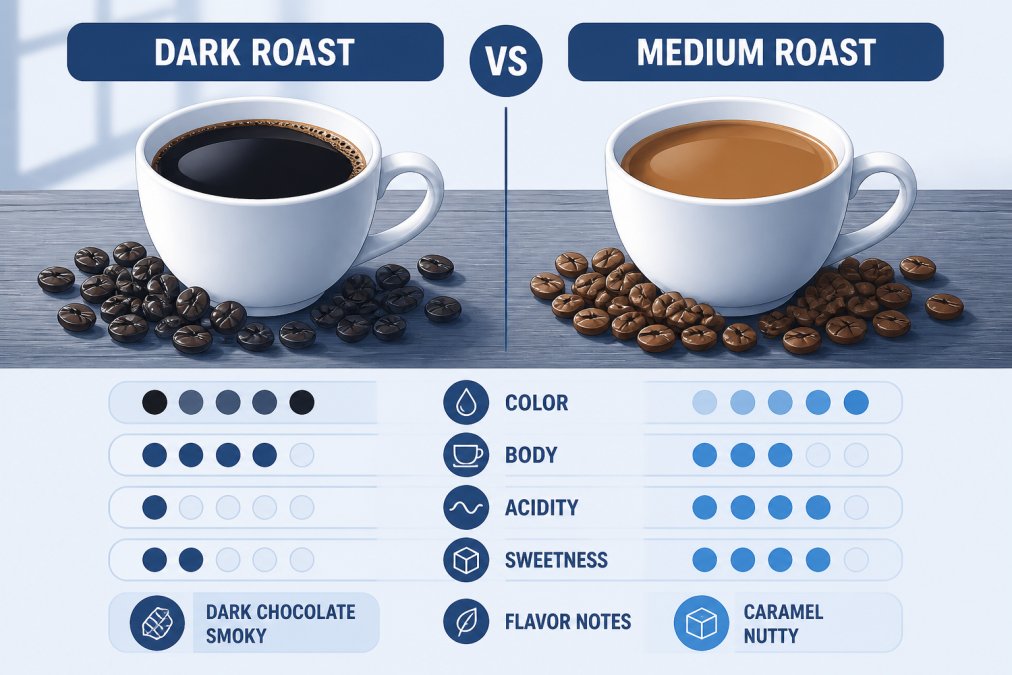
| Attribute | Medium Roast | Dark Roast |
|---|---|---|
| Roast degree | Stopped after first crack | Pushed into or past second crack |
| Acidity | Bright and noticeable | Low to muted |
| Body | Medium, silky | Full, syrupy |
| Dominant notes | Caramel, citrus, nuts | Smoke, bittersweet chocolate |
| Bean surface | Dry, matte | Oily, glossy |
| Best brewing | Pour-over, drip, AeroPress | Espresso, French press, cold brew |
Acidity in Coffee Roasts: Why Medium Beans Taste Brighter
Acidity in coffee roasts is a function of heat and time, not a defect. The longer a bean roasts, the more its natural acids break down, which is why medium roasts taste bright and lively while dark roasts taste smooth and low-acid (PubMed).
That brightness you notice in a medium roast is real chemistry. During roasting, chlorogenic acids and other organic compounds degrade steadily as temperature climbs. A medium roast halts that process early enough to preserve a portion of those acids, and the cup reads as crisp, fruity, or tea-like depending on origin.
How Roasting Destroys Acids
Heat triggers two reactions that reshape flavor: the Maillard reaction, which builds browned, toasty compounds, and caramelization, which converts sugars into sweeter, darker notes. Push the roast further and those acids keep degrading until almost nothing bright remains.
The practical result: a medium-roasted Peruvian bean keeps its salted caramel and citrus edge, while the same bean taken dark loses that sparkle and gains roasted depth instead. If you love a juicy, fruit-forward cup, a dark roast will fight you. If sharp acidity upsets your stomach, dark is the friendlier choice.
Body and Mouthfeel: Syrup vs Silk
Body and mouthfeel describe the physical weight of coffee on your tongue, and roast level drives both. Dark roasts feel heavier and more syrupy; medium roasts feel silkier, lighter, and cleaner.
Two things create that weight. First, dark roasting drives oils to the bean's surface, and those oils carry dissolved solids into the cup. Second, longer roasting develops more of the bittersweet compounds that coat the palate. A French roast poured from a press feels almost like warm syrup, while a medium breakfast blend glides across the tongue and finishes clean.

Bean density plays a supporting role. Dense, high-grown beans hold up to a darker roast without turning hollow, which is why a well-developed dark roast still tastes full rather than flat or ashy.
That mouthfeel difference changes how you drink the coffee. Medium roasts reward slow sipping because the texture shifts as the cup cools. Dark roasts stay rich and consistent from first sip to last, which is part of why they pair so well with milk and cream.
Tasting Notes by Roast Level
Tasting notes shift predictably as roast degree increases, moving from fruit and caramel toward smoke and bittersweet depth.
Medium Roast: Caramel, Citrus, and Balance
A medium roast keeps origin flavors intact. The bean's terroir, meaning the soil, altitude, and climate where it grew, still shows through. You'll find caramel, toasted nuts, citrus, and stone fruit, all held together by a balanced structure where sweetness and acidity trade places.
A medium-roasted Mexican bean from Chiapas often reads as chocolate, cinnamon, and green apple. A medium Peruvian cup leans toward salted caramel with a silky, sweet citrus finish. These are the coffees that taste like where they came from.
Dark Roast: Smoke, Bittersweet, and Depth
Dark roasting mutes origin character and turns up roast character. Expect smoky, earthy, chocolatey notes with a bittersweet edge and a long, lingering finish. A well-executed dark roast tastes like dark chocolate and toasted nuts, not ash.
This is where the roast profile matters most. A French roast built from high-scoring African beans develops an oil sheen and a bold, bittersweet backbone that stands up to milk, cream, and any brewing method. Push too far, though, and you get charred, one-dimensional coffee that tastes the same no matter where the beans grew.
Caffeine Content in Medium vs Dark Roast: The Myth
Caffeine content in medium vs dark roast is nearly identical, and the popular belief that dark roast hits harder is a myth. Caffeine is heat-stable, so roasting barely touches it (peer-reviewed research). What changes is the bean's mass, not its caffeine.
Here's the mechanism. Beans lose water and organic material during roasting, so a dark-roasted bean weighs less than a medium-roasted one. If you scoop by volume, you'll pack more dark beans into the same spoon, which nudges the caffeine slightly higher. Weigh your coffee instead of scooping it and the difference essentially disappears.
The bigger caffeine variable is your brew method and ratio, not the roast level. A strong espresso from a light medium roast can carry more caffeine per serving than a weak drip cup from an extra-dark bean. If caffeine is your priority, adjust your dose and grind, not your roast.
Best Brewing Methods for Dark Roast Coffee
The best brewing methods for dark roast coffee are the ones that tame bitterness and lean into body: espresso, French press, and cold brew. But the method alone isn't enough, dark roasts need specific grind and temperature adjustments to taste their best. Here's how to dial in each brewer for a dark roast, and how those settings shift when you switch to a medium roast.
Espresso
Dark roasts are the traditional choice for espresso because their surface oils help build a thick, persistent crema and their bittersweet notes cut through milk. The trade-off is that dark roasts extract faster, so a grind that works for a medium roast will often pull bitter and ashy on a dark one.
- Grind: Fine, but slightly coarser than you'd use for a medium or light roast. If your medium-roast espresso grind sits at a 4 on a stepless grinder, start a dark roast around 5 and adjust from there.
- Dose and yield: A common starting ratio is 1:2 (18 g in, 36 g out) in roughly 25-30 seconds (sca.coffee). Dark roasts often taste best pulled a touch shorter, closer to 1:1.5 to 1:1.8, to avoid dragging out the bitter tail.
- Water temperature: 195-200°F. Drop toward the lower end for very dark (French or Italian) roasts; medium roasts generally prefer 200-205°F.
French Press
French press suits dark roasts because the metal mesh filter lets the oils through, giving you the full, syrupy texture the roast is known for. The immersion method is also forgiving of the fines that dark, brittle beans produce.
- Grind: Coarse, roughly the texture of sea salt. Dark beans shatter more easily, so if your burr grinder produces a lot of fines, sift them out or expect a muddier cup.
- Ratio: 1:15 by weight (about 30 g coffee to 450 g water) is a solid baseline. Dark roasts can handle 1:14 if you want more intensity.
- Water temperature: 195-200°F. Because immersion extraction is slow and even, cooler water keeps the bitter compounds in check.
- Time: 4 minutes total, then press slowly and decant immediately so the grounds stop extracting.
Cold Brew
Cold brew is the most forgiving method for dark roasts. Low temperature extracts sweetness slowly and leaves much of the bitterness behind, producing a smooth, chocolatey concentrate that keeps for about a week in the refrigerator.
- Grind: Coarse, similar to French press but slightly coarser to make filtering easier.
- Ratio: 1:8 for a concentrate you dilute 1:1 with water or milk, or 1:15 for ready-to-drink.
- Time: 12-18 hours at room temperature or 18-24 hours in the refrigerator. Dark roasts hit their sweet spot on the shorter end; medium roasts can go longer without turning harsh.
Pour-Over and Drip
Where dark roasts struggle is pour-over. Paper filters trap the oils, and the bright, delicate notes that make pour-over sing are exactly what dark roasting removes. If you brew dark roast in a pour-over anyway, use a coarser grind and slightly cooler water to keep bitterness in check.
- Grind: Medium-coarse, closer to drip than to a typical pour-over setting.
- Water temperature: 190-195°F, noticeably cooler than the 200-205°F you'd use for a medium roast.
- Ratio: 1:16 to 1:17 to keep the cup from turning heavy and muddy.
Medium roasts are the opposite. They shine in pour-over and drip, where clarity and acidity come through, and they hold up fine in an AeroPress. Match the method to the roast, and then match the grind and temperature to the roast, and both taste better.
Health Benefits and Antioxidant Variations
Antioxidant levels drop as roast degree increases, so medium roasts generally carry more of the chlorogenic acids linked to coffee's health benefits than dark roasts do. But the story is more interesting than a simple 'lighter is healthier' headline, and the mechanism explains why both roasts still earn a place in a healthy routine.
What Actually Happens During Roasting
Green coffee beans are loaded with chlorogenic acids, a family of polyphenol antioxidants that make up a meaningful share of the bean's dry weight before roasting. As roast time and temperature climb, those compounds break down through two main pathways:
- Thermal degradation. Chlorogenic acids are heat-sensitive. A medium roast, stopped shortly after first crack, preserves a larger fraction of them. A dark roast, pushed into or past second crack, degrades most of what was there.
- Maillard reaction products. The same heat that destroys chlorogenic acids creates new compounds, including melanoidins, the brown pigments responsible for a dark roast's color and much of its bittersweet flavor. Melanoidins have their own antioxidant activity, so a dark roast isn't nutritionally empty; it simply trades one class of antioxidants for another.
The practical takeaway: medium roasts tend to test higher for total antioxidant activity in published comparisons, but the gap narrows when you account for melanoidins, and both roast levels deliver meaningful antioxidant content per cup.
Beyond Antioxidants
Roast level also affects a few other compounds drinkers care about:
- Caffeine. Essentially unchanged by roasting. Caffeine is heat-stable, so the popular belief that dark roast hits harder is a myth. Any difference you notice comes from scooping by volume, dark beans weigh less, so a scoop holds more of them, not from the roast itself.
- N-methylpyridinium (NMP). This compound forms during roasting and increases with darker roast levels. It's one reason dark roasts tend to be gentler on the stomach; NMP appears to reduce gastric acid secretion compared with lighter roasts.
- Acidity. The organic acids that give medium roasts their brightness degrade with longer roasting, which is why dark roasts are often the friendlier choice for drinkers with acid sensitivity or reflux.
How to Think About It
If you drink coffee partly for its antioxidant content, a medium roast gives you more of the chlorogenic acids per cup. If you drink it for flavor and lower acidity, a dark roast still contributes antioxidants through melanoidins and may sit easier on a sensitive stomach. Neither choice is a mistake.
What matters most is how you take it. Loading either roast with sugar and heavy cream will outweigh any antioxidant advantage, so keep additions modest if health is your goal. And remember that total caffeine intake, not roast level, is the variable most linked to the health outcomes researchers study.
How to Choose the Right Roast for Your Palate
Choosing the right roast starts with one question: do you want brightness or depth? Medium roasts deliver clarity, acidity, and origin character. Dark roasts deliver body, low acidity, and roasted sweetness. Answer that honestly and the decision takes about ten seconds.
Use this framework to match roast to taste:
- You enjoy fruity, tea-like, or citrusy notes → choose medium
- You want caramel, chocolate, and nutty sweetness → medium or medium-dark
- You prefer smoky, bittersweet, or bold flavors → choose dark
- You drink your coffee with milk or cream → dark roast holds up better
- You have acid sensitivity or reflux → dark roast is gentler
- You brew pour-over or drip → medium roast shows more character
- You brew espresso, French press, or cold brew → dark roast shines
- You want an easy way to compare both → start with a sampler
If you're genuinely undecided, don't commit to a full bag of one style. A sample pack lets you taste a dark house blend, a medium breakfast blend, and single origins side by side, which is the fastest way to learn your own preference. Venro Coffee Co. delivers specialty coffee and artisan tea straight to your door, so the comparison reflects the coffee at its peak rather than a bag that's been sitting on a shelf.

The mistake most people make is assuming dark roast is "stronger" and medium is "weaker." They're not stronger or weaker, just different. Pick the flavor profile you actually enjoy and brew it well.
Most drinkers spend years defaulting to whatever roast their grocery store stocks, never realizing the flavor they actually want sits one roast level away. Venro Coffee Co. roasts to order and delivers specialty coffee and artisan tea straight to your door, with single origins, signature blends like our Cowboy Blend, and convenient single-serve capsules to match any brewing setup. Start with the Best Sellers Sample Pack to taste both a dark house blend and medium single origins side by side, then build your ritual around the profile you love. Shop Coffee with Venro Coffee Co. and taste the difference fresh roasting makes.
Frequently Asked Questions
Which coffee tastes better, medium roast or dark roast?
Neither roast is objectively better; it depends on your preference for brightness versus depth. Medium roasts preserve origin flavors like citrus, caramel, and floral notes, making them ideal for pour-over or drip. Dark roasts emphasize smoky, bittersweet, and chocolatey tones with lower acidity, which suits espresso and French press. Try a sample pack with both roast levels to compare side by side before committing to a full bag.
Is dark roast coffee stronger in flavor?
Dark roast coffee tastes stronger because roasting longer develops bold, smoky, and bittersweet notes while reducing acidity. However, 'stronger' is subjective. A dark roast has more intense roasted flavors but less origin character. Medium roasts offer a balanced cup where you can still taste fruity or nutty notes. If you want a heavy-bodied, low-acid cup, dark roast delivers that intensity. If you prefer brightness and complexity, medium roast is the better choice.
Does roast level affect the caffeine content of my coffee?
Roast level has almost no effect on caffeine content when measured by weight. Dark and medium roasts contain nearly identical caffeine levels before brewing. However, because dark roast beans lose more mass during roasting, a scoop of dark roast may weigh less than a scoop of medium roast, resulting in slightly less caffeine per scoop. For consistent caffeine, measure coffee by weight rather than volume.
Which coffee roast is the smoothest?
Dark roasts are generally smoother because extended roasting reduces acidity and bitterness from under-extraction. The Maillard reaction and caramelization create a heavier body and lower perceived acidity, giving a velvety mouthfeel. Medium roasts can also be smooth if brewed correctly, but their brighter acidity may taste sharper to some palates. If smoothness is your priority, look for a dark roast with low acidity like a French or Italian roast.
How does the roasting process change the bean's natural characteristics?
Roasting transforms green coffee beans through heat, triggering the Maillard reaction and caramelization. Medium roasts stop before second crack, preserving origin flavors like fruit, floral, and caramel. Dark roasts continue past second crack, where oils migrate to the surface and origin flavors fade into smoky, bittersweet, and chocolatey notes. The longer the roast, the more the bean's natural acidity and terroir are replaced by roast character.