



How to Make Pour Over Coffee Less Bitter: 2026 Guide
Table of Contents
- Why Your Pour Over Coffee Tastes Bitter
- The Coffee Grind Size Chart for Pour Over
- The Ideal Water Temperature for Pour Over
- Nailing Your Pour Over Brew Ratio
- Step-by-Step: How to Make Pour Over Coffee Less Bitter
- Pouring Technique and Agitation: The Bloom Phase
- Roast-Specific Adjustments for Bitterness
- The Salt Hack: Does It Really Work?
- Common Mistakes to Avoid
- Frequently Asked Questions
Last Updated: September 12, 2026
Why Your Pour Over Coffee Tastes Bitter
Bitterness in pour over coffee comes down to one thing: over-extraction. When hot water pulls too many soluble compounds from the grounds, you taste harsh, drying bitterness instead of the sweetness and clarity a good pour over should deliver. This guide from Venro Coffee Co. breaks down exactly how to make pour over coffee less bitter, from grind size to pouring technique.

The fix is rarely one dramatic change. It's usually a small correction in one of five variables: grind size, water temperature, brew ratio, contact time, or pouring technique. Change one at a time, taste the result, and adjust again.
Over-Extraction vs. Under-Extraction
Over-extraction happens when water stays in contact with coffee too long, when the grind is too fine, or when water is too hot. The result is bitterness, astringency, and a dry mouthfeel.
Under-extraction is the opposite problem: thin body, sharp sourness, and a salty finish. Many home brewers assume bitterness means they should coarsen the grind dramatically. That's a common mistake. A small adjustment is usually enough, and overshooting pushes you straight into sour territory.
The Coffee Grind Size Chart for Pour Over
For pour over, medium-fine is the target: roughly the texture of table salt. A coffee grind size chart helps you match grind to brew method, and for pour over specifically, you want particles that look like coarse sand with a few larger pieces mixed in.
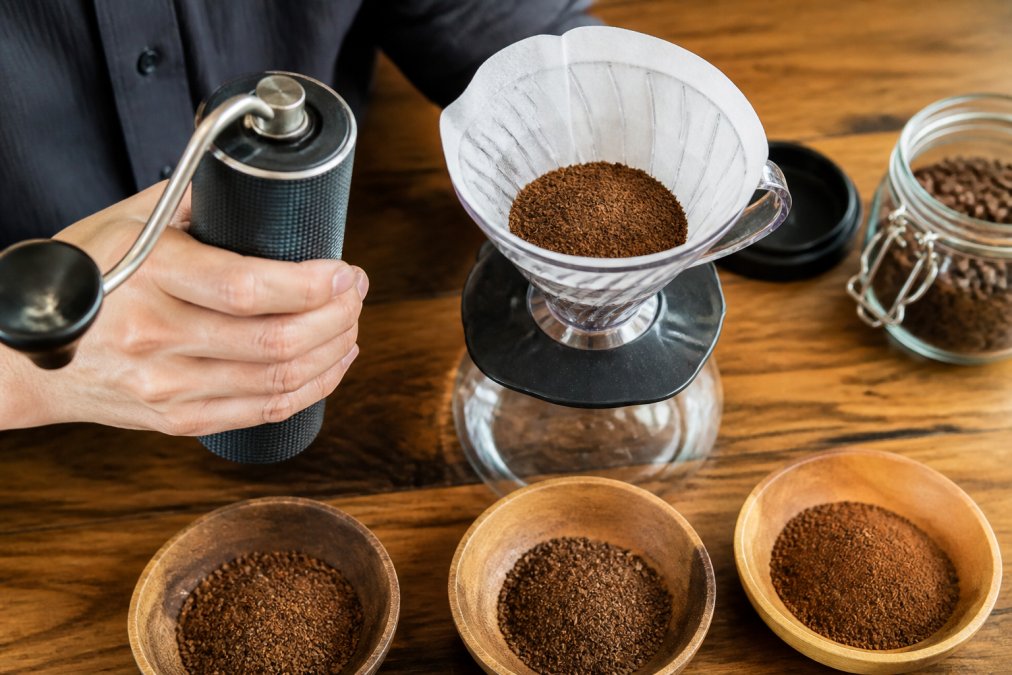
Here's a practical reference for dialing in:
| Grind Size | Texture Reference | Typical Brew Method | Bitterness Risk |
|---|---|---|---|
| Fine | Powdered sugar | Espresso | High |
| Medium-fine | Table salt | Pour over | Moderate |
| Medium | Coarse sand | Drip machine | Low |
| Coarse | Sea salt | French press | Low |
If your pour over tastes bitter, move one step coarser. If it turns sour, move back half a step.
A Visual Grind Size Guide for Faster Dialing In
Most guides describe grind size in words, but your eyes and fingers are faster than a chart. Use these physical comparisons to match your grind without a microscope:
- Table salt (medium-fine): The grains stick to your fingertips but brush off easily. When you rub them between your fingers, you feel grit, not powder. This is your starting point for pour over.
- Coarse sand (medium): Feels like the sand at the beach just above the waterline. Individual grains are visible and distinct.
- Sea salt (coarse): Large, irregular crystals that crunch when pressed. This is French press territory.
A simple test: put a pinch of grounds on a white plate and compare it side-by-side with a pinch of table salt. If your coffee looks like flour, it's too fine for pour over. If it looks like peppercorns, it's too coarse.
Roast-Specific Grind Adjustments
Dark roasts are more porous and extract faster, so they often need a slightly coarser grind to avoid bitterness. Light roasts are denser and resist extraction, so they can handle a finer grind without turning bitter. If you switch roasts and don't adjust your grind, you may blame the beans when the real issue is particle size.
Burr Grinder vs. Blade Grinder
A burr grinder crushes beans between two burrs at a set distance, producing uniform particles. A blade grinder chops beans with spinning blades, creating a mix of fine dust and large boulders. Those fines over-extract while the boulders under-extract, so you get bitterness and sourness in the same cup. Consistency is the single biggest upgrade most home brewers can make.
The Ideal Water Temperature for Pour Over
The ideal water temperature for pour over sits between 195°F and 205°F (sca.coffee). Water above 205°F scorches the grounds and pulls out harsh compounds fast; water below 195°F under-extracts and leaves the cup tasting flat and sour.
Most electric kettles overshoot their target, so let the water rest for 30 seconds after boiling before you pour. If you're brewing a dark roast, aim for the lower end of the range. Light roasts handle the higher end well because their denser structure resists extraction.
Nailing Your Pour Over Brew Ratio
A pour over brew ratio of 1:15 to 1:17 (coffee to water by weight) is the standard starting point (sca.coffee). That means roughly 20 grams of coffee to 300-340 grams of water for a single cup.
Too little coffee relative to water produces a weak, bitter-leaning cup because the water over-extracts what's there. Too much coffee and you get an under-extracted, sour result. A digital scale removes the guesswork entirely; volume scoops vary too much between bean types to be reliable.
Step-by-Step: How to Make Pour Over Coffee Less Bitter
Follow these steps in order, and adjust only one variable per brew so you can track what actually changed the flavor.
- Heat water to 200°F and let it rest 30 seconds off boil.
- Weigh 20 grams of coffee and grind medium-fine, like table salt.
- Place a paper filter in your cone and rinse it with hot water to remove paper taste.
- Add grounds and pour 40 grams of water to saturate them. Wait 30 to 45 seconds for the bloom.
- Pour in slow spirals, keeping the water level steady, until you reach 320 grams total.
- Let the bed draw down fully. Total brew time should land between 2:30 and 3:30.
- Taste. If bitter, coarsen the grind one step. If sour, go finer.
The full process takes about four minutes from start to cup.
Pouring Technique and Agitation: The Bloom Phase
The bloom phase is the first pour, when hot water hits the grounds and releases trapped carbon dioxide. Skipping or rushing it causes uneven extraction, which is one of the most common sources of bitterness.
Pour gently, just enough to saturate all the grounds, then wait. Aggressive pouring or stirring during the bloom disturbs the coffee bed and creates channeling, where water finds a single path through the grounds instead of extracting evenly. Keep your pour rate slow and steady, and avoid letting the water level drop so low that the bed dries out mid-brew.
How to Pour for Even Extraction
A controlled pour is the difference between a balanced cup and a bitter one. Here's a technique that works with any cone:
- Bloom pour: Start at the center and spiral outward in small circles, using about twice the weight of your coffee in water (for 20 grams of coffee, use 40 grams of water). Stop when all grounds are saturated.
- Wait 30 to 45 seconds. The bed will bubble and expand. If it doesn't, your coffee may be stale.
- Main pour: Pour in slow, steady spirals from the center outward, keeping the water level consistent. Avoid pouring directly onto the filter paper, which bypasses the coffee bed.
- Finish: Once you reach your total water weight, give the cone a gentle swirl to level the bed and let it draw down.
A gooseneck kettle gives you the control to pour a thin, steady stream. A standard kettle dumps water too fast and creates turbulence.
Agitation: When to Stir and When to Leave It Alone
Agitation increases extraction by exposing more coffee surface area to water. Too much agitation, especially with a fine grind, pushes you into bitterness. Too little leaves flavor behind.
- During bloom: A gentle stir with a spoon or a quick swirl of the cone helps saturate dry pockets. Do this once, not repeatedly.
- During main pour: Let the water do the work. Stirring here is usually unnecessary and risks channeling.
- After pour: A single gentle swirl to level the bed is fine. Vigorous shaking is not.
Roast-Specific Pouring Adjustments
Dark roasts extract quickly, so shorten your bloom time to 20-30 seconds and pour slightly faster to reduce total contact time. Light roasts benefit from a full 45-second bloom and a slower pour to maximize extraction. If you're brewing a dark roast and it still tastes bitter after adjusting grind and temperature, try reducing your total brew time by 15-30 seconds.
Roast-Specific Adjustments for Bitterness
Dark roasts extract faster than light roasts because their cell structure is more porous after longer roasting. If you're brewing a dark roast, drop your water temperature by about 5°F and shorten total contact time slightly.
Light roasts, like Venro Coffee Co.'s Breakfast Blend or Costa Rica single origin, are denser and need more heat and slightly more time to extract fully. This is where most guides fall short: they give one universal recipe and ignore that roast profile changes everything. Match your variables to the roast, not to a fixed chart.

The Salt Hack: Does It Really Work?
Adding a tiny pinch of salt to bitter coffee does reduce perceived bitterness (PubMed). Salt interacts with your taste receptors and suppresses bitterness perception without changing the actual extraction. It's a real effect, not a myth.
But here's the honest limitation: salt masks bitterness, it doesn't fix it. If your pour over is bitter because of over-extraction, salt makes a flawed cup drinkable rather than good. Use it as a rescue tool when you're stuck, not as your regular routine. Fix the extraction first.
Common Mistakes to Avoid
The same handful of errors show up again and again when people troubleshoot bitterness.
- Grinding too fine for the brew time you're using
- Pouring water straight off a rolling boil
- Skipping the bloom or rushing it under 20 seconds
- Using stale or pre-ground coffee that has already oxidized
- Eyeballing measurements instead of weighing
Freshness matters more than most people realize. Coffee starts losing volatile compounds within weeks of roasting, and pre-ground coffee stales far faster than whole bean. A freshly roasted bean, ground right before brewing, gives you a much wider margin for error on every other variable. Venro Coffee Co. roasts and ships directly to your door, which keeps that window tight.
Frequently Asked Questions
Why does my pour over coffee taste bitter?
Bitterness in pour over coffee usually comes from over-extraction, which happens when hot water pulls too many compounds from the grounds. Common causes include water that is too hot (above 205°F), a grind that is too fine, or a brew time that runs too long. Adjusting one variable at a time, starting with grind size, helps you identify the culprit and fix it.
Does grind size affect coffee bitterness?
Yes, grind size is one of the biggest factors. A fine grind exposes more surface area to water, speeding up extraction and pulling out harsh tannins and chlorogenic acid that taste bitter. For pour over, a medium-fine grind (like table salt) is a good starting point. If your cup tastes bitter, coarsen the grind slightly and try again.
How does water temperature impact coffee extraction?
Water temperature controls how quickly compounds dissolve from the coffee grounds. The ideal water temperature for pour over is between 195°F and 205°F. Water above 205°F can scorch the grounds and extract harsh, bitter flavors, while water below 195°F may leave you with a sour, under-extracted cup. Use a variable-temperature kettle for the most control.
Should I use a coarser grind to reduce bitterness?
A coarser grind is often the quickest fix for bitter pour over. When you grind coarser, water flows through the coffee bed faster, reducing contact time and limiting how much bitterness gets extracted. Start by adjusting your grinder two clicks coarser, then taste the result. If the cup turns sour, go one click finer to find the balance.
Bitterness in pour over coffee is almost always a fixable extraction problem, not a flaw in your beans. Adjust one variable at a time, start with grind size, and taste your way to a cleaner cup. If you want beans fresh enough to make dialing in easier, Venro Coffee Co. offers single origins like Ethiopia Natural and Costa Rica, plus blends roasted and delivered straight to your door. Shop Coffee and give your next pour over the starting point it deserves.