



Arabica vs Robusta Coffee Beans: Key Differences
Table of Contents
- Arabica vs Robusta at a Glance
- Caffeine Content in Arabica vs Robusta
- Flavor Profile and Taste Notes
- Bean Shape, Size, and Physical Differences
- Growing Conditions: Altitude, Climate, and Plant Height
- Acidity, Bitterness, and Oil Content
- Processing Methods: Washed vs Natural
- Price, Market Availability, and Sustainability
- Best Specialty Coffee Beans for Home Brewing
- Frequently Asked Questions
Last Updated: September 13, 2026
Arabica vs Robusta at a Glance
The difference between arabica and robusta coffee beans comes down to two species with distinct chemistry, growing needs, and flavor outcomes. Arabica (Coffea arabica) is the species behind most specialty coffee: lower in caffeine, higher in perceived acidity, and grown at elevation. Robusta (Coffea canephora) is hardier, higher in caffeine, and heavier in body and bitterness. This guide from Venro Coffee Co. breaks down where each one wins, where it falls short, and how to choose beans that match your brewing setup.
Here is the short version before the detail: arabica is the flavor-first bean, robusta is the structure-first bean. Neither is "better" in the abstract. The right pick depends on whether you're chasing nuance or crema, and on what's in your grinder.
| Attribute | Arabica | Robusta |
|---|---|---|
| Caffeine | Lower | Roughly double |
| Flavor | Sweet, fruity, complex | Bitter, earthy, nutty |
| Bean shape | Oval, flat | Rounder, smaller |
| Growing altitude | High (900-2,000 m) | Low (0-800 m) |
| Plant height | Shorter, delicate | Taller, hardy |
| Acidity | Bright, pronounced | Low |
| Oil content | Lower on bean surface | Higher |
| Price | Higher | Lower |
| Common use | Single-origin, specialty | Espresso blends, instant |
Caffeine Content in Arabica vs Robusta
Robusta contains roughly twice the caffeine of arabica by weight, and that single fact explains most of the downstream differences between the two species. Caffeine is a natural pesticide, so the plant that evolved in low-altitude, pest-heavy environments invested in more of it. Arabica, growing in cooler highlands with fewer threats, didn't need the same chemical armor.
That gap matters in the cup for two reasons. First, caffeine is bitter, so robusta's higher caffeine load contributes directly to its sharper, harsher finish. Second, if you're blending for an espresso that "wakes you up," robusta gets you there with less coffee.
A common mistake is assuming a dark roast has more caffeine than a light roast. It doesn't, not meaningfully. Roast level changes flavor and bean density far more than it changes caffeine content. If you want a gentler caffeine hit without giving up flavor, a medium roast arabica from a high-altitude origin is the practical answer, and that's where most specialty roasters put their effort.
Flavor Profile and Taste Notes
Flavor is where arabica separates itself, but the reason is chemistry, not marketing. Arabica carries more sucrose and a wider spread of fruit acids developed during slow, cool ripening, and those compounds are what a roaster is trying to preserve. Robusta delivers a flatter, more bitter, more earthy cup because it has less sugar to caramelize and more of the bitter compounds that survive roasting intact.
Arabica's flavor profile leans on its organic compounds and sugar content, which is why you get tasting notes like blackcurrant, citrus, cocoa, or wine in a well-roasted arabica. Robusta's profile is heavier and simpler: dark chocolate, peanut, grain, and a lingering bitterness that some espresso drinkers actually want for balance.
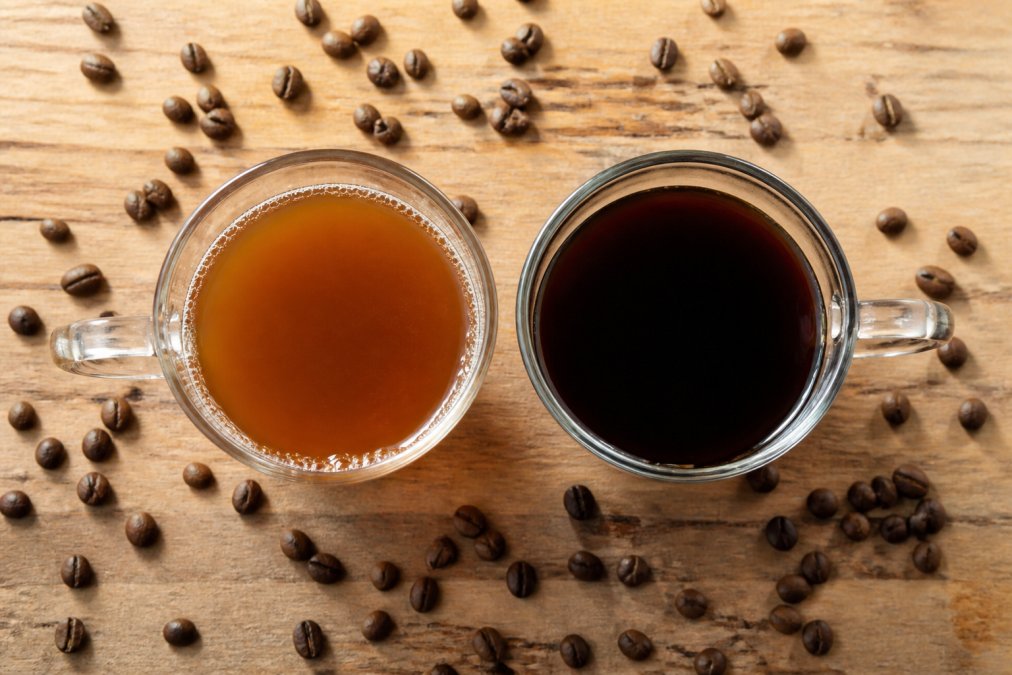
Here's the part most guides gloss over: robusta's "harshness" is often a processing and roasting problem, not an inherent flaw. A carefully processed, well-roasted robusta can taste clean and nutty. It just won't taste like a Kenyan arabica, and it isn't trying to.
How the same bean tastes different by brew method
This is the angle most comparisons skip, and it changes the answer to "which tastes better." The same arabica and the same robusta will not read the same way across brewers, because each method extracts differently.
- Pour over and filter: Arabica wins clearly. Paper filtration strips most oils and lipids, so what reaches the cup is the acid and sugar profile. A washed arabica's citrus and floral notes come through clean; a robusta through the same brewer tends to taste hollow and ashy because its bitterness has nothing to balance against.
- French press: The metal mesh lets oils and fine particles through, which adds body and rounds off acidity. This is the one method where a well-roasted robusta can hold its own, and where a natural-process arabica can taste syrupy and fruit-forward rather than sharp.
- Espresso: Robusta's higher surface oil and lower acidity produce a thicker, more persistent crema and a heavier mouthfeel. Traditional espresso blends lean on robusta for exactly that texture. A pure arabica espresso tastes cleaner and more complex but pours a thinner, faster-fading crema.
- Moka pot: Closer to espresso in pressure but without the same extraction control, so robusta's bitterness can dominate. A medium-roast arabica is the safer pick here.
- Cold brew: Low-acid extraction favors arabica's sweetness and mutes robusta's harsh edges, which is why cold brew is one of the few formats where a robusta-heavy blend can taste smooth rather than blunt.
What actually drives the bitterness
Bitterness in coffee comes from a few sources, and species is only one of them. Caffeine is bitter, and robusta has roughly double the caffeine, so that contributes. Chlorogenic acid lactones, formed during roasting, are another major bitter driver, and they build up as roast level increases. That's why a dark-roasted arabica can taste more bitter than a medium-roasted robusta, even though the species-level expectation says otherwise.
The practical takeaway: if you dislike bitter coffee, roast level and brew ratio will move your experience more than the species label on the bag. If you dislike sour or thin coffee, species and processing matter more.
Bean Shape, Size, and Physical Differences
You can often tell the two species apart by looking at the bean. Arabica beans are typically oval, slightly larger, and flatter, with a curved center cut. Robusta beans are rounder, smaller, and more convex, with a straighter center line. Once you've handled both, the difference is obvious in a handful.
Bean shape isn't just trivia, it's a practical sorting tool. Green coffee buyers use screen size and shape to grade lots, and the physical differences track with the chemical ones. Arabica's denser, flatter bean reflects the slow, high-altitude growing conditions that concentrate flavor. Robusta's rounder, smaller bean reflects faster, lower-altitude growth.
Specialty Coffee Association's green coffee grading standards outlines how bean size, density, and defect count feed into quality classification. Density is the one to watch: denser beans generally roast more evenly and hold more of their origin character.
Growing Conditions: Altitude, Climate, and Plant Height
Altitude is the single biggest environmental variable separating the two species. Arabica thrives between roughly 900 and 2,000 meters, where cool temperatures slow cherry development and concentrate sugars and acids. Robusta grows comfortably from sea level up to about 800 meters, tolerating heat that would stress an arabica plant.
Plant height differs too. Arabica plants are typically shorter and more delicate, often pruned to keep them manageable. Robusta plants grow taller and more vigorously, with broader leaves and deeper roots. That vigor is why robusta is cheaper to farm: it resists pests and disease with far less intervention.
Why altitude changes the cup
The mechanism is temperature, not altitude itself. At higher elevations, cooler air slows the cherry's maturation, which gives the bean more time to develop sugars and organic acids. Faster ripening at low elevation produces a bean with less of both, which is why low-grown arabica tastes flatter than high-grown arabica of the same variety. Robusta evolved in warm lowlands and simply doesn't need the slow-ripening window to reach its full expression.
This is also why "high-grown" on a bag is a meaningful signal for arabica and largely irrelevant for robusta. The label only tells you something when the species benefits from the condition.
Climate change is reshaping the species split
This is the angle most comparisons skip entirely, and it's the one with the longest shelf life. Arabica's narrow temperature band is the problem. As growing regions warm, the altitude at which arabica can be viably farmed moves upward, and there is a ceiling: mountains run out of elevation. Growers in established arabica regions face a choice between moving uphill, switching crops, or investing in shade and irrigation to buffer rising heat.
Robusta's heat and drought tolerance make it the structural hedge. It produces more per acre, needs less intervention, and tolerates conditions that would ruin an arabica harvest. The industry consequence is already visible: robusta is being planted in regions that historically grew only arabica, and the quality ceiling for well-processed robusta has risen as more investment flows into it.
What this means for the price you pay
Arabica's narrow growing range, pest susceptibility, and slower maturation make it expensive to produce. Robusta's hardiness and higher crop yield make it the economical choice, which is why it dominates instant coffee and budget blends. When arabica supply tightens, that cost flows through to the shelf, and robusta becomes the substitution roasters reach for.

USDA coffee market and trade data tracks how origin and species affect pricing at the commodity level, which is worth a look if you want to understand why a single-origin arabica costs what it does.
For home buyers, availability is rarely the problem. Both species are widely sold. The real question is provenance: whether the beans were carefully sourced and roasted recently enough to matter. Freshness and traceability do more for your cup than the species on the label.
Acidity, Bitterness, and Oil Content
Arabica tastes brighter and more acidic; robusta tastes more bitter and carries more surface oil. Those two traits, acidity and oil, drive most of the sensory differences people notice without knowing why.
Arabica's perceived acidity comes from its chlorogenic acid content and the fruit acids developed during slow ripening. That brightness reads as "lively" or "zesty" to some drinkers and "sour" to others. Robusta's lower acidity and higher bitterness make it taste flatter but heavier, with a longer, drier finish.
Oil content matters most for espresso. Robusta beans carry more surface oils, which help produce a thick, persistent crema. That's the real reason traditional espresso blends include robusta: not for flavor, but for texture and that signature golden foam. Arabica-dominant espresso can taste cleaner and more complex, but the crema is thinner and fades faster.
| Trait | Arabica | Robusta |
|---|---|---|
| Acidity | High, bright | Low |
| Bitterness | Low to moderate | High |
| Surface oil | Lower | Higher |
| Crema in espresso | Thinner | Thick, persistent |
| Best brewing match | Pour over, filter, drip | Espresso, moka, French press |
Processing Methods: Washed vs Natural
Processing method shapes flavor as much as species does, and it's the angle most comparisons skip entirely. Washed processing removes the fruit before drying, producing a cleaner, brighter cup with more clarity. Natural processing dries the cherry with the fruit intact, producing heavier body, more sweetness, and fermented fruit notes.
For arabica, washed processing is the specialty default because it lets origin character show through. Natural-processed arabicas are bolder and fruitier, sometimes wildly so. For robusta, washed processing is the best route to a cleaner cup, since it strips away some of the earthy harshness that natural processing can amplify.
Coffee processing methods explained by the National Coffee Association notes that processing decisions are made at the farm, long before roasting, and they lock in much of what you'll eventually taste. When you read "fully washed" on a bag, that's a signal of clarity and consistency, not just a marketing line.
Price, Market Availability, and Sustainability
Arabica costs more, robusta costs less, and the gap comes down to farming difficulty. Arabica's narrow growing range, pest susceptibility, and slower maturation make it expensive to produce. Robusta's hardiness and higher crop yield make it the economical choice, which is why it dominates instant coffee and budget blends.
Sustainability is where robusta's story gets more interesting. As growing conditions shift, arabica's high-altitude range becomes less reliable, pushing growers to higher ground and threatening supply. Robusta's heat and drought tolerance make it a hedge. Many in the industry now argue that robusta deserves more respect as a quality crop, not just a filler.
For home buyers, availability is rarely the problem. Both species are widely sold. The real question is provenance: whether the beans were carefully sourced and roasted recently enough to matter. Freshness and traceability do more for your cup than the species on the label.
Best Specialty Coffee Beans for Home Brewing
For most home brewers, arabica is the better starting point, and the practical way to test that is to brew the same method across a few origins. Venro Coffee Co. roasts single-origin arabicas specifically for this kind of exploration, and the differences between them are exactly what makes the arabica-versus-robusta conversation concrete.
A few options worth working through:
- Nicaragua Single Origin ($19.99): medium roast with cocoa, floral, and citrus tones. Balanced body, smooth finish, and flexible across drip, pour over, French press, and espresso.
- Kenya Single Origin ($19.99): medium-light roast with blackcurrant, bright citrus, and wine-like complexity. Best in pour over and filter, where its clarity shows.
- Uganda Single Origin ($19.99): medium-dark roast with dark chocolate and earthy depth. Full-bodied and smooth, ideal for French press and espresso if you want richness without the sharpness of a dark roast.
- Mexico Single Origin Pods ($19.99): washed Chiapas arabica with lemon, brown sugar, and dark chocolate. A 12-pack of single-serve capsules for mornings when you have ninety seconds and no patience for a scale.
- Venro Instant Coffee Blend with Mushroom Coffee Blend ($24.99): arabica base with Lion's Mane, Cordyceps, and Reishi. Thirty servings, hot water only.
USDA coffee market and trade data tracks how origin and species affect pricing at the commodity level, which is worth a look if you want to understand why a single-origin arabica costs what it does.

If you want to taste the arabica-versus-robusta split for yourself, brew a washed arabica and a robusta blend back to back using the same method and ratio. The difference lands in the first sip.
Choosing between these two species isn't about picking a winner, it's about matching the bean to how you actually drink coffee. If you want brightness, complexity, and origin character, arabica delivers it. That's the lane Venro Coffee Co. works in: freshly roasted single origins, signature blends, single-serve capsules, and artisan teas, all shipped to your door. Get started with Venro Coffee Co. and elevate your morning cup.
Frequently Asked Questions
Which coffee is better, Robusta or Arabica?
Neither is objectively better; they serve different purposes. Arabica offers complex, fruity, and acidic flavors, making it ideal for single-origin pour-over or filter brewing. Robusta provides a bold, bitter, and earthy taste with higher caffeine, which works well in espresso blends for a thick crema and in instant coffee. Your choice depends on whether you prioritize nuanced flavor or a strong, punchy cup.
How do I know if my coffee is Arabica or Robusta?
Check the bag's label. Arabica beans are typically oval and larger, while Robusta beans are smaller and rounder. Arabica coffee often lists specific origins like Ethiopia or Colombia, while Robusta is common in blends labeled 'espresso' or 'instant.' Roasters may not always disclose the species, but specialty coffee bags usually state '100% Arabica' if that's the case.
Does Robusta have more caffeine than Arabica?
Yes, Robusta typically contains about twice the caffeine of Arabica. On average, Robusta beans hold around 2.2% caffeine by weight, while Arabica has roughly 1.2%. This higher caffeine content contributes to Robusta's bitter taste and makes it a popular choice for instant coffee and espresso blends where a strong kick is desired.
Why is Arabica coffee generally more expensive than Robusta?
Arabica plants are more delicate, requiring higher altitudes, specific climates, and more care during cultivation. They also yield less per plant and are more susceptible to pests and disease. Robusta is hardier, grows at lower elevations, and produces more crop yield, making it cheaper to farm. These factors, plus Arabica's premium flavor, drive its higher market price.
What are the primary flavor profile differences between Arabica and Robusta?
Arabica tends to be sweeter, fruitier, and more acidic, with notes of chocolate, nuts, and berries. Robusta is bolder, more bitter, and earthy, often described as grainy or woody with a heavier body. Arabica's complex aroma and clean finish make it a favorite for black coffee, while Robusta's strong, straightforward taste shines in milk-based drinks.