



Kazan Coffee vs Fresh Roasted: Which Stays Fresher Longer
Table of Contents
- Kazan Coffee vs Fresh Roasted: Core Differences
- Understanding the Coffee Roast Date Importance
- Signs of Stale Coffee Beans and Flavor Degradation
- How to Store Fresh Roasted Coffee for Maximum Shelf Life
- Brewing Method Variance and Freshness Impact
- Economic Trade-Offs: Price vs Freshness
- Kazan Coffee vs Fresh Roasted: Which Should You Choose
- Conclusion
Last Updated: August 6, 2026
Kazan Coffee vs Fresh Roasted: Core Differences
Kazan coffee refers to beans roasted in traditional Turkish-style shallow, wide-bottomed pans that allow manual stirring and precise heat control. Fresh roasted coffee is roasted in commercial drum roasters or smaller batch equipment, then shipped quickly to consumers within their peak flavor window. The roasting method directly influences how beans age, how volatile compounds escape, and how long coffee stays flavorful.
The kazan method produces a distinctly different aromatic profile and degassing pattern compared to modern roasting equipment. The core difference is timing: fresh roasted coffee begins degrading the moment roasting stops as oxygen, light, heat, and moisture accelerate oxidation and flavor loss. Kazan-roasted beans, traditionally prepared in smaller batches and consumed locally, were designed for immediate use. Modern fresh roasted coffee is engineered for shipping and storage realities, but only if handled correctly.
Understanding the Coffee Roast Date Importance
The roast date is your single most important piece of information when buying coffee. It tells you exactly when beans were removed from heat, which determines whether they're still degassing, at peak flavor, or already oxidizing.
The moment roasting ends, beans begin releasing carbon dioxide and volatile compounds through off-gassing or degassing. Fresh roasted beans need 12-24 hours minimum before brewing to allow excess CO2 to escape. Brew too soon, and extraction becomes chaotic, disrupting the even saturation that produces balanced flavor.
How Roasting Triggers Off-Gassing and Flavor Development
When beans reach desired roast temperature, the Maillard reaction continues at the molecular level while aromatic compounds and essential oils are released as volatile gases. This is why fresh roasted coffee smells intensely fragrant in the first week; those aromatic compounds are literally escaping into the air.
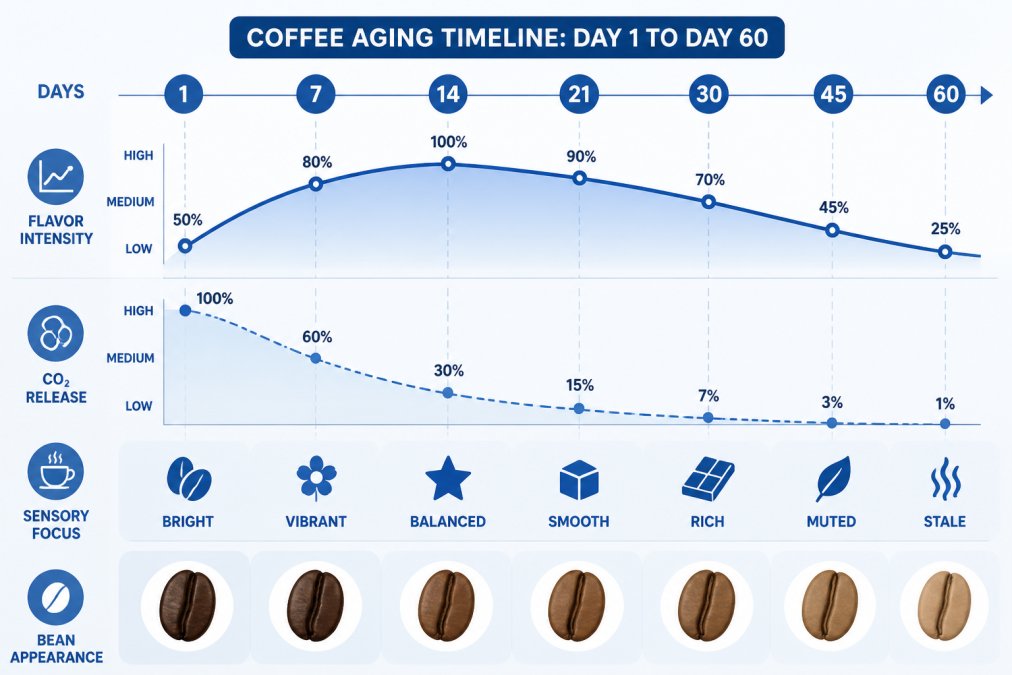
The off-gassing process follows a predictable curve. In the first 24-48 hours after roasting, CO2 release is most aggressive, beans lose 50-70% of their total CO2 during this window. One-way valve bags become critical, allowing CO2 to escape without letting oxygen back in, protecting beans from oxidation while they complete chemical stabilization. After 48 hours, degassing slows significantly. By day 5, most beans have released 80-90% of their CO2, becoming stable enough for optimal extraction.
The Peak Flavor Window: A Timeline from Roast to Stale
For most specialty coffees, the peak flavor window opens around day 5-7 after roasting and closes around day 21-30.
Day 1-2 (Immediate Post-Roast): Beans are still degassing heavily. Extraction is chaotic. Flavor is muddled by residual heat and unstable compounds.
Day 3-5 (Early Development): Degassing continues at slower rate. Aromatic compounds begin stabilizing. Brewing is possible but not optimal; acidity may taste sharp.
Day 5-14 (Peak Window Opens): Degassing is 85-95% complete. Aromatic compounds have stabilized. Acidity is bright but balanced. Body is full. Flavor notes are distinct and complex.
Day 14-30 (Peak Plateau): Beans maintain peak flavor characteristics. Oxidation occurs slowly enough that loss is imperceptible. This is the ideal window for purchase and consumption.
Day 30-45 (Decline Phase): Oxidation becomes noticeable. Aromatic compounds degrade. Acidity flattens. Sweetness diminishes. Flavor becomes less complex.
Day 45+ (Stale): Significant oxidation has occurred. Beans taste flat and one-dimensional. Aromatic complexity has largely disappeared.
This timeline varies based on storage conditions. Beans stored in cool, dark, airtight containers with minimal oxygen exposure can extend their peak window by 5-10 days. Beans stored in clear bags on kitchen counters degrade 2-3 weeks faster.
Practical Implications for Purchasing and Brewing
Buying coffee on the roast date doesn't mean it's at its best. A bag roasted today will be better in 10 days. Fresh roasted coffee should arrive within a week of roasting, giving you the full peak flavor window ahead. Ask local roasters for the roast date and plan purchases for beans that are 5-10 days old, not 1-2 days old.
For subscription services or online orders, the roast date should always be visible on the bag. Reputable roasters print the roast date prominently and often include a "best by" date reflecting their estimate of the peak window's end.
Signs of Stale Coffee Beans and Flavor Degradation
Stale coffee tastes flat. The aromatic complexity collapses into one-dimensional sweetness or bitterness. The acidity disappears. The body becomes thin. Flavor degradation happens through loss of volatile aromatic compounds and oxidation of oils and acids that create brightness and complexity.
Visual and Sensory Indicators of Oxidation
The first visual sign of aging is loss of sheen. Fresh roasted beans have slight oily appearance with visible surface texture. As oxidation progresses, beans become matte and dull. The color shifts slightly, becoming less vibrant.
Fresh beans release aroma immediately when the bag is opened. Older beans release aroma more slowly. When grinding fresh beans, the smell is sharp and complex. Grinding older beans produces duller, flatter aroma. The bloom phase also tells the story: fresh beans produce vigorous, sustained bubbling; older beans produce minimal bloom because there's less CO2 and fewer volatile compounds.
Taste is the final arbiter. Fresh roasted coffee within its peak window tastes clean with distinct flavor notes and balanced acidity. Beyond 30-40 days, the flavor becomes hollow, acidity flattens, and sweetness disappears.
How to Store Fresh Roasted Coffee for Maximum Shelf Life
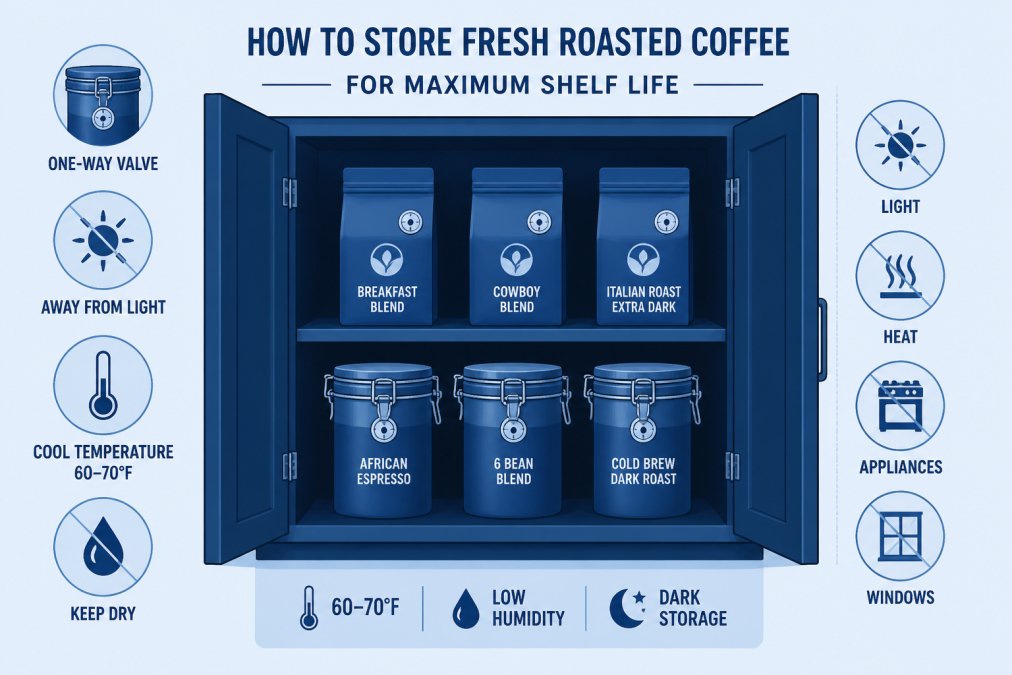
Proper storage extends your peak flavor window and slows oxidation that degrades specialty coffee. The enemy is oxygen; every contact with oxygen molecules begins oxidizing aromatic compounds and oils. Light accelerates this process, heat speeds up oxidation exponentially, and moisture allows oxidation to proceed and can trigger mold growth.
Container Types and One-Way Valve Benefits
The best containers are opaque, airtight, and equipped with one-way valves. These valves allow gas to escape in one direction only, preventing backflow of air. Vacuum-sealed bags with one-way valves are the industry standard. Once you open the bag, that seal is broken. Transfer beans to an airtight container with a one-way valve. Glass jars with rubber seals work if you add a separate one-way valve. Opaque ceramic or stainless steel containers are better because they block light entirely. Avoid clear plastic containers and never store coffee in the refrigerator or freezer; condensation introduces moisture that degrades flavor.
Temperature, Light, and Moisture Control
The ideal storage temperature is 50-70°F. Room temperature (68-72°F) is acceptable. Above 75°F, oxidation accelerates noticeably. Avoid kitchens with direct sunlight, ovens, or heat-generating appliances. A dark cabinet or pantry away from exterior walls works well.
Humidity should stay below 60%. Most homes naturally maintain 40-50% humidity, which is ideal. If your storage area feels damp, add a small silica gel packet to your container and replace it every 2-3 months.
Whole beans stay fresh longer because they have less surface area exposed to oxygen. Ground coffee oxidizes rapidly, typically within 15-30 minutes of grinding. Use pre-ground coffee within a week. For whole beans stored properly, you have 30-40 days at peak flavor, then acceptable flavor for another 10-20 days before significant degradation becomes obvious.
| Storage Factor | Ideal Condition | Impact on Shelf Life |
|---|---|---|
| Temperature | 50-70°F | ±5°F changes degradation rate significantly |
| Light | Complete darkness | Blocks UV-triggered oxidation |
| Humidity | 40-60% | Above 65% risks mold; below 30% dries beans |
| Container | Opaque, airtight, valve | Extends peak window by 2-3 weeks |
| Grind size | Whole beans | Extends shelf life 3-4x vs. ground |
Brewing Method Variance and Freshness Impact
Different brewing methods extract compounds at different rates and temperatures, meaning they tolerate aging differently.
Espresso: The Freshness-Sensitive Method
Espresso forces hot water through grounds under pressure (typically 9 bars) for 25-30 seconds, extracting compounds rapidly and completely. The state of beans, how much CO2 they contain, how stable their aromatic compounds are, and how much oxidation has occurred, dramatically affects shot quality.
Beans in days 1-5 post-roast produce excessive crema and erratic extraction. CO2 still escaping interferes with water penetration, creating uneven saturation. Some grounds over-extract, producing bitter, ashy flavors. Others under-extract, producing sour, thin shots.
Beans in days 7-21 post-roast are optimal for espresso. Degassing is 85-95% complete, so CO2 no longer disrupts extraction. A well-pulled shot tastes balanced with sweetness, acidity, and body all present. For espresso, the optimal window is narrow: days 7-21 for most specialty blends, with acceptable quality extending to day 28-30 for darker roasts.
Pour-Over and Drip: Moderate Freshness Tolerance
Pour-over and automatic drip methods use lower water temperature, longer contact time (3-5 minutes), and gravity-driven extraction. The slower, gentler process means older beans still produce acceptable coffee because extended contact time allows remaining aromatic compounds to develop.
Beans in days 5-35 post-roast produce excellent pour-overs. The optimal window is wider than espresso because slower extraction compensates for some lost volatility. A 25-day-old bean still produces balanced coffee with distinct flavor notes. For pour-over, the practical window is days 5-35, with acceptable quality extending to day 45-50.
French Press: Maximum Forgiveness
French press uses full immersion extraction, grounds steep in hot water for 4 minutes, then a metal filter separates liquid from solids. This method is most forgiving of bean age because extended contact time and full immersion extract maximum flavor from remaining aromatic compounds.
Beans in days 4-50 post-roast produce good to acceptable French press coffee. Even a 45-day-old bean can produce flavorful French press because the 4-minute immersion extracts remaining compounds effectively. For French press, the practical window is days 4-50, with acceptable quality extending to day 60 or beyond with ideal storage.
Cold Brew: The Longest Shelf Life
Cold brew uses cold water immersion for 12-24 hours. Low temperature means oxidation proceeds slowly during brewing, and extended contact time extracts remaining flavor compounds effectively. Cold brew is most forgiving for bean age.
Beans in days 3-60+ post-roast produce good cold brew. Even a 60-day-old bean can produce smooth, flavorful cold brew because the 12-24 hour immersion extracts remaining compounds without over-extraction. For cold brew, the practical window is days 3-90, making it ideal for people who buy coffee sporadically.
Turkish Coffee (Kazan): Traditional Tolerance
Kazan coffee uses finely ground beans (powder-fine) mixed with water and spices in a small pot, brought to a boil, then poured into cups. This method is relatively forgiving with bean age because fine grind and direct contact with hot water extract remaining compounds effectively. A 30-day-old bean can still produce flavorful Turkish coffee.
Beans in days 4-40 post-roast produce good Turkish coffee. The fine grind and hot water extraction pull out remaining flavor compounds. The coffee is strong, dark, and full-bodied. Beyond day 40, Turkish coffee becomes noticeably flatter.
Practical Brewing Freshness Guide
| Brewing Method | Optimal Window | Acceptable Window | Why |
|---|---|---|---|
| Espresso | Days 7-21 | Days 5-30 | Pressure-driven extraction is sensitive to CO2 and aromatic stability |
| Pour-Over | Days 5-35 | Days 4-45 | Slower extraction compensates for some aromatic loss |
| French Press | Days 4-40 | Days 3-60 | Full immersion extracts remaining compounds effectively |
| Cold Brew | Days 3-60 | Days 2-90 | Cold temperature and long immersion maximize extraction of remaining compounds |
| Turkish Coffee | Days 4-35 | Days 3-40 | Fine grind and hot water extraction tolerate moderate aging |
If you're buying fresh roasted coffee but brewing it in a French press or cold brew, you can purchase beans that are 2-3 weeks old and still get excellent results. Espresso drinkers need beans that are 5-14 days old. Pour-over drinkers have the most flexibility; they can buy beans at any point in the 5-35 day window and get good results.
Economic Trade-Offs: Price vs Freshness
Specialty coffee costs more than commodity coffee because of sourcing, roasting precision, and freshness logistics. Fresh roasted coffee shipped to your door costs more than beans sitting on shelves for months. The economic question is straightforward: what are you paying for? Premium fresh roasted coffee costs more upfront but you're paying for single-origin traceability, careful roasting that maximizes flavor, and rapid shipping that preserves the peak flavor window.
The alternative is buying cheaper coffee and accepting that you're drinking beans oxidizing for weeks or months. Supermarket coffee is often 2-4 months old by the time it reaches shelves. At that age, you're not tasting the bean's origin characteristics or the roaster's skill; you're tasting baseline coffee flavor after oxidation has stripped away nuance.
For daily drinkers on a budget, the calculation changes. If you brew 3-4 cups per day, fresh roasted specialty coffee becomes expensive. But the difference between premium fresh roasted and stale commodity coffee is often just 10-20% in price, a reasonable premium for dramatically better flavor.
Kazan Coffee vs Fresh Roasted: Which Should You Choose
Kazan coffee and fresh roasted coffee aren't direct competitors. Kazan coffee is a preparation method; fresh roasted coffee is a product state. You can make kazan coffee with fresh roasted beans or with months-old beans.
If your question is really "Should I buy traditionally roasted Turkish coffee or specialty fresh roasted coffee delivered to your door?", the answer depends on your priorities. Turkish coffee roasting prioritizes a specific flavor profile: dark, intense, slightly smoky, with heavy body. Fresh roasted specialty coffee prioritizes origin clarity and the roaster's craft.
For flavor complexity and tasting what makes a particular origin special, fresh roasted coffee wins decisively. A fresh roasted single-origin Ethiopia has floral and fruity notes that dark Turkish roast obscures. For consistent, bold flavor and traditional preparation, kazan coffee wins.
The practical advantage of fresh roasted coffee is flexibility. The same beans work in espresso, pour-over, French press, or Turkish preparation. With kazan coffee, you're locked into one preparation method.
For home baristas and coffee enthusiasts, fresh roasted specialty coffee is the better choice. Venro Coffee Co. offers single-origin options like Peru and Mexico, as well as signature blends, all roasted to order and shipped within days. The freshness window is preserved, and you get the full aromatic complexity that makes specialty coffee worth the premium price. Convenient single-serve capsule options, available in 12-packs or 60-packs, solve the storage and freshness problem entirely; each capsule is sealed and protected until you brew it.

For traditionalists who value the ritual and specific flavor profile of Turkish coffee, kazan preparation remains unmatched. But if your goal is to taste what the roaster intended and what the origin offers, fresh roasted coffee is the only option.
The choice between kazan coffee and fresh roasted coffee ultimately comes down to what you value: tradition and ritual, or flavor complexity and freshness. If you're serious about tasting the difference between origins and experiencing how roasting skill shapes flavor, fresh roasted coffee is the answer. Venro Coffee Co. delivers freshly roasted specialty beans that preserve the peak flavor window, offering single-origin options and convenient capsule formats that eliminate the storage guesswork. Shop Coffee and experience why freshness matters.
Frequently Asked Questions
How long does coffee stay fresh after roasting?
Fresh roasted coffee peaks in flavor between 5 to 14 days after roasting, once the degassing period completes and volatile compounds stabilize. After 30 days, oxidation accelerates and flavor clarity declines noticeably. Proper storage in airtight containers with one-way valves extends shelf stability to 2-3 months, though the aromatic profile deteriorates gradually. Grind consistency and brewing method also affect how quickly you notice staleness.
Does the roast date on coffee bags really matter?
Yes. The roast date tells you when off-gassing began and helps you identify the peak flavor window for that batch. Coffee roasted 3 days ago tastes sharper and more acidic; coffee roasted 2 weeks ago displays fuller body and cleaner notes. After 4-6 weeks, rancidity sets in and essential oils break down. Checking the roast date lets you time your purchase and consumption to match your preferred aromatic profile.
What is the difference between kazan coffee and fresh roasted coffee?
Kazan coffee refers to coffee roasted in traditional Turkish copper vessels, producing a specific roast profile. Fresh roasted coffee is any coffee roasted recently and shipped quickly to preserve volatile compounds and aromatic clarity. The key difference is freshness and delivery speed. Kazan-style roasts may arrive weeks after roasting, while fresh roasted specialty services like Venro Coffee Co. ship within days, capturing peak flavor and acidity before oxidation degrades the beans.
How can I tell if my coffee beans are stale?
Stale beans show a dull, faded appearance and lack the oils visible on fresh beans. The aroma weakens, fresh coffee smells vibrant and complex; stale coffee smells flat or musty. When brewed, stale coffee tastes thin, bitter, or rancid instead of balanced with clear notes. Grind consistency also changes; stale beans crumble unevenly. If your coffee was roasted more than 6 weeks ago or stored in direct light or heat, oxidation has likely degraded the aromatic compounds and body.
What storage method keeps fresh roasted coffee freshest longest?
Use an airtight container with a one-way valve to allow CO2 escape without letting oxygen in. Store in a cool, dark cabinet away from light, heat, and moisture, never the refrigerator or freezer, which introduce condensation. Keep beans whole until brewing; grinding exposes more surface area to oxygen and accelerates flavor degradation. Proper storage extends shelf stability to 2-3 months, though peak flavor remains within the first 2-4 weeks of roasting.
This article was written using GrandRanker