



How to Choose the Right Coffee Roast: A Guide
Table of Contents
- What Is a Coffee Roast and Why It Matters
- Understanding Light Roast Characteristics
- Medium Roast Characteristics and Balance
- Dark Roast Characteristics and Bold Flavors
- Different Coffee Roast Types and Their Flavor Profiles
- Best Coffee Roast for Different Brewing Methods
- How to Choose the Right Coffee Roast for Your Taste
- Light vs. Dark Roast Coffee Health Benefits
- Understanding Coffee Roast Dates and Flavor Development
- Roast Level vs. Bean Density: What Actually Changes
- Sustainability and Ethical Sourcing in Your Roast Choice
- Common Mistakes When Choosing a Coffee Roast
- Conclusion: Making Your Roast Decision
How to Choose the Right Coffee Roast: A Guide
Last Updated: August 2, 2026
Learning how to choose the right coffee roast transforms your entire coffee experience. The difference between a light roast and a dark roast isn't just about color, it's about chemistry, flavor development, and how those beans perform in your specific brewing method. This guide breaks down everything you need to know to make confident choices that match your taste preferences, equipment, and lifestyle.

Most people assume darker always means stronger, or that roast level is the only thing that matters. Both assumptions cost you great coffee. The real story involves understanding how heat transforms green beans, recognizing how roast level changes acidity and body, and matching your selection to your brewing method.
What Is a Coffee Roast and Why It Matters
A coffee roast describes the degree to which green coffee beans have been heated during roasting. Time and temperature determine the chemical composition of the beans you brew. When roasters apply heat, they trigger the Maillard reaction and caramelization, which develop the flavors, aromas, and body you taste in your cup.
Green beans contain compounds that only emerge under specific heat conditions. Roast them too lightly and you preserve bright acidity but risk grassy, underdeveloped flavors. Roast them too dark and you lose origin characteristics, replacing them with smoky, charred notes. The sweet spot depends on what you're trying to achieve.
The Roasting Process: From Green Bean to Finished Coffee
Roasting begins when green beans enter a heated drum or air roaster at around 350°F. For the first few minutes, the beans lose moisture and appear pale yellow. Around 400°F, the Maillard reaction accelerates and flavor development truly begins.
At approximately 410°F, the beans reach "first crack," an audible popping sound marking the boundary between light and medium roasts. The beans expand, their density decreases, and their color shifts from yellow to light brown. Stop here and you get a light roast with maximum acidity and origin complexity.

Continue heating past first crack, and caramelization intensifies. The beans darken to medium brown, developing more body and sweetness while acidity decreases. Push to 425°F and beyond, and you reach second crack, indicating dark roast territory. Stop at 425°F for medium-dark roast; continue to 440°F or higher for dark or extra-dark roast with low acidity, full body, and pronounced smoky or bittersweet flavors.
How Roast Level Changes What's in Your Cup
Roast level directly affects four key variables: acidity, body, flavor intensity, and aroma complexity.
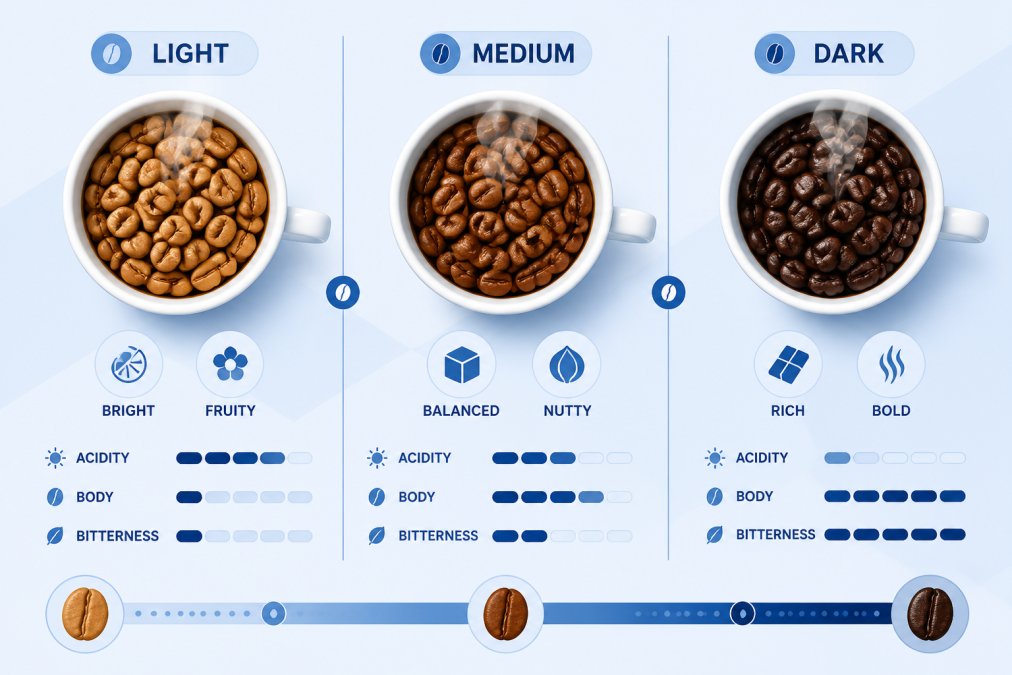
Acidity increases as roast level decreases. Light roasts have the highest acidity, not sourness, but brightness and clarity that makes coffee feel lively on your palate. Dark roasts have minimal acidity, tasting smooth and full-bodied without sharpness.
Body follows the opposite pattern. Light roasts have thin, tea-like body because beans lose less density during roasting. Dark roasts have heavy, syrupy body because extended heat breaks down cell walls and concentrates solids in the final cup.
Flavor complexity peaks in medium roasts. Light roasts showcase origin characteristics, terroir, altitude, and processing method. Dark roasts bury these nuances under roasted, smoky, or bittersweet flavors. Medium roasts balance both.
Aroma develops more pronouncedly in darker roasts. Light roasts smell grassy or floral. Dark roasts smell bold, smoky, or chocolatey because they release volatile compounds more readily as they cool.
Understanding Light Roast Characteristics
Light roasts occupy the space between first crack and early caramelization. They showcase the origin bean's natural character most clearly. If you want to taste the difference between Ethiopian and Kenyan coffee, light roasts make that distinction clear.
Flavor Profile and Brightness
Light roasts taste bright, crisp, and complex. You'll encounter floral notes, fruity tasting notes, and subtle sweetness from the bean's origin and processing method. A light roast from East Africa might taste like blueberry and jasmine. A light roast from Central America might taste like apple, chocolate, and nuts.
This brightness comes from higher acidity, not unpleasant sourness, but the quality that makes coffee taste alive and clear on your palate. It creates complexity and makes different origins taste distinctly different.
Light roasts also have lighter body and thinner mouthfeel, more like tea than syrup. This lets subtle flavors shine through without heavy sweetness or bitterness masking them.
Acidity and Body in Light Roasts
Light roasts deliver maximum acidity and minimum body. This combination works beautifully for specific brewing methods and palates. If you enjoy bright, nuanced coffee and don't mind a thinner mouthfeel, light roasts are your category.
The acidity comes from chlorogenic acid and other compounds that survive the shorter roasting time. These acids create clarity and definition, think of acidity as the difference between a blurry photo and a sharp one.
Body refers to how the coffee feels in your mouth. Light roasts feel light because less time in the roaster means less breakdown of cell walls, resulting in fewer dissolved solids. Some people love this delicate sensation; others find it too thin.
Venro Coffee Co.'s Breakfast Blend - Light Roast exemplifies this profile with tasting notes of walnuts, mild apple, slight raisin, and toffee, demonstrating how light roasts preserve origin sweetness and complexity while maintaining brightness.
Medium Roast Characteristics and Balance
Medium roasts represent the middle ground. They roast long enough to develop caramelized sweetness and fuller body, but not so long that roasted flavors overwhelm origin character. This balance makes medium roasts the most forgiving category and the most versatile across brewing methods.
The Sweet Spot: Complexity and Sweetness
Medium roasts taste sweet, balanced, and approachable. You get some of the origin brightness from light roasts combined with the roasted sweetness that emerges during caramelization. Tasting notes might include chocolate, caramel, nuts, and subtle fruit, a mix of what the bean naturally offers and what roasting creates.
The body is medium: fuller than light roasts but not as heavy as dark roasts. This mouthfeel feels satisfying without being overwhelming. The acidity is moderate, still present enough to create definition, but lower than light roasts.
Medium roasts also offer excellent flavor consistency. Because the roasting window is wider, slight variations don't dramatically change the final cup. This makes medium roasts reliable and predictable. If you're new to specialty coffee or unsure about your preferences, medium roast is the safest starting point.
Dark Roast Characteristics and Bold Flavors
Dark roasts push past second crack into territory where the roasting process dominates the flavor profile. Origin characteristics fade, replaced by bold, smoky, and bittersweet notes. If you want coffee that tastes powerful and doesn't require much thought about subtlety, dark roast delivers.
Smoky, Bittersweet, and Low Acidity Profiles
Dark roasts taste smoky, bold, and full-bodied. Tasting notes often include dark chocolate, smoke, leather, and burnt sugar, flavors that come almost entirely from the roasting process rather than the bean's origin. A dark roast Ethiopian and a dark roast Brazilian taste far more similar than their light roast counterparts.
The acidity in dark roasts is minimal, meaning the coffee tastes smooth without sharpness. If you're sensitive to acidity or prefer a gentler coffee experience, dark roast's low acidity is a major advantage.
Body is full and heavy, syrupy, rich, and coating. This heaviness comes from extended roasting that breaks down cell walls and concentrates dissolved solids. If you love the sensation of a full-bodied coffee, dark roast delivers.
Venro Coffee Co. offers dark roast options like [Italian Roast - Dark](https://www.venrocoffee.com/products/italian-roast-1) and French Roast - African, crafted for people who appreciate bold, bittersweet profiles with rich aroma and minimal acidity.

Different Coffee Roast Types and Their Flavor Profiles
Beyond the three main categories, roasters create variations designed for specific purposes.
Single-Origin vs. Blend Roasts
Single-origin coffees come from one farm, region, or country. They showcase the unique characteristics of that specific place, altitude, climate, soil, and processing method. A single-origin Kenyan light roast tastes completely different from a single-origin Brazilian light roast. Single-origin coffees work best in light and medium roasts, where origin character survives the roasting process.
Blends combine beans from multiple origins. Roasters blend to create consistency, balance flavor profiles, or reduce costs. A breakfast blend might combine a bright Central American bean with a full-bodied African bean to create something balanced enough for morning drinking.
Venro Coffee Co. offers both single-origin and blend options. Their Blonde is a light blend celebrating smooth, bright, and approachable flavors.
Tasting Notes and Aroma Development
Tasting notes describe the flavors you'll experience. These notes come from the bean's origin and the roasting process. Floral and fruity notes appear more in light roasts. Chocolate, caramel, and nutty notes appear more in medium and dark roasts.
Aroma is what you smell when you open the bag or brew the coffee. Aroma development increases with roast level. Light roasts smell subtle and floral. Dark roasts smell bold and smoky. Some people choose roasts based entirely on aroma preference.
Degassing is the process by which roasted coffee releases CO2 after roasting. For the first 24-48 hours, coffee actively degasses and isn't ideal for brewing. After 5-7 days, coffee enters its "peak flavor window" where degassing has slowed enough for optimal extraction but the coffee hasn't yet staled. This window lasts roughly 2-3 weeks for light roasts and 3-4 weeks for dark roasts.
| Roast Level | Acidity | Body | Flavor Focus | Aroma Intensity | Best Brewing Method |
|---|---|---|---|---|---|
| Light | High | Thin | Origin character | Subtle | Pour-over, AeroPress |
| Medium | Moderate | Medium | Balanced | Moderate | Drip, French press |
| Dark | Low | Full | Roasted notes | Bold | French press, espresso |
Best Coffee Roast for Different Brewing Methods
Your brewing method should influence your roast choice. Different brewing methods extract coffee differently, and roast level affects how that extraction performs. The relationship between roast, grind size, and brewing device is where most people make mistakes.
Brewing Method Compatibility: Grind Size and Extraction
Pour-over and AeroPress work best with light roasts. These methods use paper or metal filters and contact times of 2-4 minutes. The shorter contact time means you need acidity and brightness to create clarity. Light roasts deliver this. If you use a dark roast in a pour-over, you'll get a thin, one-dimensional cup.
For pour-overs, grind light roast to a medium-fine consistency, similar to sea salt. The beans are denser, so finer grinding is necessary to expose enough surface area for proper extraction in 3-4 minutes. If your pour-over tastes sour or thin, your grind is too coarse; if it tastes bitter or slow to drip, your grind is too fine.
AeroPress works similarly but offers more control. Use a medium-fine grind with light roast, brew for 1-2 minutes depending on your method, and aim for water temperature around 195-205°F.
French press and immersion brewing work best with medium and dark roasts. These methods involve 4+ minutes of coffee steeping in hot water. The longer contact time extracts heavily, pulling out oils and thick body. Medium and dark roasts have the body and lower acidity needed to taste balanced with this extraction. A light roast in a French press tastes thin and sour because extended steeping over-extracts the acidity without developing the body to balance it.
For French press, grind dark roast coarsely, similar to breadcrumbs. Dark roast beans are less dense and break apart easily; a fine grind will over-extract and taste burnt. Brew for 4 minutes with water around 200°F. Medium roasts should use a medium-coarse grind and 4-5 minutes of steeping.
Espresso works with any roast, but medium and dark roasts are traditional because they balance espresso's intensity. Espresso's high pressure and short contact time extract quickly and intensely. Dark roasts' lower acidity and full body balance espresso's intensity without tasting thin or sour.
For espresso, grind medium roast to a fine, powdery consistency and tamp with consistent pressure (around 30 pounds). Aim for a 25-30 second pull with a 1:2 ratio. Dark roasts may need slightly coarser grinding to prevent over-extraction.
Drip coffee makers are forgiving and work with any roast. However, medium roast is the safest choice because it balances acidity and body across different machines and water temperatures. Most automatic drip machines brew at 195-205°F and contact times of 5-10 minutes, which suits medium roast perfectly.
For drip machines, use a medium grind, similar to sand. If coffee tastes weak or sour, grind finer. If it tastes bitter, grind coarser.
Moka pot (stovetop espresso) works best with medium and dark roasts. Moka pots use steam pressure and brew in 5-10 minutes. Grind medium roast to a fine consistency, slightly coarser than espresso but finer than pour-over. Fill the bottom chamber with water just below the safety valve, pack the basket without tamping, and screw on the top chamber. Brew over medium heat until you hear a gurgling sound, then remove from heat immediately.
Turkish coffee requires very fine grinding and works best with dark or medium roast. Grind to a powder finer than espresso. Add cold water and finely ground coffee to the cezve at a 1:1 ratio by weight, stir, and heat slowly. When foam rises to the top, remove from heat, stir, and return to heat. Repeat twice more, then pour into small cups.
Grind Size and Roast Level Interaction
Density differences between roast levels require grind adjustments. Light roast beans are denser and harder; they require finer grinding to expose surface area for extraction. Dark roast beans are less dense and softer; they require coarser grinding to avoid over-extraction.
If you use the same grind size for light and dark roasts, the dark roast will over-extract and taste bitter or ashy, while the light roast will under-extract and taste sour or thin. A practical rule: if switching between roast levels using the same brewing method, adjust your grind size. Moving from light to dark roast? Go one notch coarser on your grinder. Moving from dark to light roast? Go one notch finer.
Troubleshooting by Brewing Method and Roast
| Brewing Method | Roast Level | Tastes Sour/Thin | Tastes Bitter/Burnt | Solution |
|---|---|---|---|---|
| Pour-over | Light | Too coarse | Too fine | Adjust grind finer or coarser; check water temp (aim for 195-205°F) |
| Pour-over | Dark | Expected (avoid) | Too fine | Use light or medium roast instead; if using dark, grind coarser |
| French press | Light | Expected (avoid) | Brew time too long | Use medium or dark roast instead; if using light, reduce brew time to 2-3 min |
| French press | Dark | Grind too fine | Grind too fine | Grind coarser; reduce brew time to 3-4 min |
| Espresso | Light | Grind too coarse | Grind too fine | Adjust grind; lower water temp to 190°F |
| Espresso | Dark | Grind too coarse | Grind too fine or over-tamped | Adjust grind; check tamp pressure (aim for 30 lbs) |
| Drip | Medium | Grind too coarse | Grind too fine | Adjust grind; check water temp |
| Moka pot | Dark | Grind too coarse | Grind too fine | Adjust grind; reduce heat to medium |
How to Choose the Right Coffee Roast for Your Taste
Now that you understand the characteristics of each roast level, here's how to choose based on your actual preferences and situation.
Step 1: Identify Your Flavor Preferences
Start by asking yourself what flavors you enjoy. Do you like bright, fruity, floral coffee? Choose light roast. Do you like sweet, balanced, approachable coffee? Choose medium roast. Do you like bold, smoky, full-bodied coffee? Choose dark roast.
The best way to discover your preference is to buy small quantities of light, medium, and dark roasts from the same origin or a quality roaster. Brew them the same way using the same equipment. Taste them side by side. Pay attention to what you actually enjoy, not what you think you should enjoy.
Step 2: Match Roast Level to Your Brewing Equipment
Once you know your flavor preference, match it to your brewing method. If you love bright, complex coffee but only own a French press, you have two choices: either buy a pour-over or AeroPress to brew your light roast properly, or compromise and choose medium roast instead.
If your brewing method is fixed, let it influence your roast choice. French press owners should lean toward medium and dark roasts. Pour-over owners should lean toward light and medium roasts.
Step 3: Consider Bean Origin and Processing Method
Origin and processing method affect flavor independently of roast level. A naturally processed Ethiopian bean tastes fruity and floral regardless of whether it's light or dark roasted. A washed Colombian bean tastes clean and balanced regardless of roast level.
If you love fruity, floral flavors, seek out Ethiopian or Kenyan coffees with natural processing. If you love chocolate and nuts, seek out Brazilian or Colombian coffees with washed processing. Over time, you'll develop preferences for specific origins roasted specific ways.
Step 4: Check the Roast Date and Freshness
This is the most overlooked factor in choosing coffee. Roast date matters more than roast level. A light roast from three weeks ago tastes worse than a dark roast from three days ago.
Buy coffee roasted within 2-7 days before you receive it. If the roast date is older than two weeks, the coffee has begun to stale. The bag should clearly display the roast date; if it doesn't, that's a red flag.
Fresh coffee tastes brighter, more complex, and more flavorful. Stale coffee tastes flat and dull. When you order, you're getting coffee roasted recently and delivered directly to your door.
Light vs. Dark Roast Coffee Health Benefits
People often ask whether roast level affects coffee's health properties. The answer is nuanced: roast level does change the chemical composition, but both light and dark roasts offer health benefits.
Caffeine Content Across Roast Levels
Contrary to popular belief, roast level doesn't significantly affect caffeine content. Light roasts and dark roasts contain nearly identical amounts of caffeine. The myth that dark roast has more caffeine comes from the fact that dark roast beans are less dense, so a scoop of dark roast contains fewer beans by weight than a scoop of light roast. If you measure by weight, the caffeine is nearly identical.
Brewing method affects caffeine more than roast level. Espresso has more caffeine per ounce than drip coffee because of the pressure and intensity of extraction. French press has slightly more caffeine than pour-over because the longer steeping time extracts more caffeine.
Antioxidants and Nutritional Differences
Coffee contains chlorogenic acid and other antioxidants that survive roasting. Light roasts contain more chlorogenic acid because less time in the roaster means less degradation. However, dark roasts develop different antioxidants during the roasting process. The net antioxidant content is similar across roast levels, just different types.
Research suggests coffee drinkers, regardless of roast level, experience benefits like reduced risk of certain diseases and improved cognitive function. The differences between roast levels are minor compared to the benefits of drinking coffee regularly.
Understanding Coffee Roast Dates and Flavor Development
The period between roasting and drinking is critical. Understanding roast dates and flavor development helps you buy coffee at the right time and store it properly.
Why Roast Date Matters More Than Expiration
Coffee doesn't truly expire, but it degrades through a predictable timeline. Immediately after roasting, coffee is actively degassing, releasing CO2 trapped inside the beans. For the first 24-48 hours post-roast, this degassing is intense and interferes with extraction. CO2 escaping from the coffee bed during brewing creates channels that allow water to flow through unevenly, leading to under-extraction in some areas and over-extraction in others.
After 5-7 days, degassing slows significantly. The coffee enters its "peak flavor window," the period when it tastes best. During this window, degassing has slowed enough for even water distribution and optimal extraction, but the coffee hasn't yet begun to stale. This window lasts roughly 2-3 weeks for light roasts and 3-4 weeks for dark roasts.
Dark roasts have a longer peak window because they're roasted longer, meaning more volatile flavor compounds have already been transformed during roasting. What remains is more stable and resistant to oxidation. Light roasts retain more volatile aromatic compounds that oxidize more quickly once exposed to air.
After the peak window closes, the coffee begins to stale. Oxidation accelerates, and volatile aromatic compounds continue to degrade. After 6-8 weeks, most coffee tastes noticeably stale, flat, muted, and lacking clarity. After 3 months, it's past its prime for specialty coffee standards.
The roast date tells you where in this timeline the coffee sits:
- Roasted 1-4 days ago: Still actively degassing; not ideal for brewing yet.
- Roasted 5-10 days ago: Entering peak flavor; excellent for brewing.
- Roasted 10-21 days ago (light roast) or 10-28 days ago (dark roast): Peak flavor window; ideal for brewing.
- Roasted 21-42 days ago: Past peak but still good; noticeable loss of brightness and complexity.
- Roasted 60+ days ago: Noticeably stale; flat and muted flavors.
Degassing and Peak Flavor Window
Degassing is an invisible but critical process. As CO2 escapes, the coffee's flavor clarifies and develops. This is why coffee tastes better a week after roasting than it does three days after roasting.
During the first 24-48 hours, degassing is most active. CO2 bubbles escape rapidly, especially if the coffee is ground or exposed to air. This is why freshly roasted whole beans taste harsh or flat if brewed immediately.
From days 3-7, degassing continues but at a slower rate. The coffee's flavor begins to stabilize. Volatile compounds that were too sharp or harsh begin to mellow. The coffee's natural sweetness emerges.
From days 7-21 (light roast) or 7-28 (dark roast), degassing slows further, and the coffee reaches its peak. Flavor is balanced, brightness is clear, and body is full.
After the peak window, oxidation becomes the dominant process. Oxygen in the air reacts with the coffee's compounds, degrading flavor and aroma. This process accelerates if the coffee is exposed to light, heat, or humidity.
Storage and the Peak Flavor Window
Storage conditions dramatically affect how quickly coffee stales. Coffee stored in an airtight container at room temperature in a dark location stays fresh longer than coffee exposed to air, light, or heat.
Airtight containers: Use opaque, airtight containers like glass jars with rubber seals or commercial coffee canisters. Avoid clear containers, which allow light to degrade the coffee. Avoid paper bags, which allow air and moisture to enter. Avoid the freezer for short-term storage; freezing and thawing causes condensation that promotes staling.
Temperature: Store coffee at room temperature, ideally between 60-70°F. Avoid warm locations like above the stove or near a window. Heat accelerates oxidation and staling.
Light: Store coffee in a dark location. Light exposure degrades flavor compounds through photodegradation. This is why specialty coffee roasters use opaque bags with one-way valves.
Humidity: Store coffee in a dry location. Moisture causes the coffee to absorb odors and promotes mold growth.
With proper storage, coffee stays at peak flavor for the full duration of its peak window. Without proper storage, coffee stales faster.
Buying Coffee at the Right Stage
The ideal coffee to buy is roasted 5-10 days before you receive it. This timing ensures the coffee has finished its initial degassing but hasn't yet begun to stale. When you receive it, it will be entering or already in its peak flavor window, giving you 1-3 weeks to drink it at its best.
Check the roast date on the bag before buying. Reputable roasters clearly display the roast date. If the roast date is missing, that's a red flag.
If you're buying online, check the roast date before purchasing. If the roast date is older than 2 weeks at the time of purchase, the coffee will be past peak by the time it arrives. If the roast date is within 2-7 days of the purchase date, you're in good shape.
Roast Level vs. Bean Density: What Actually Changes
Understanding what physically changes during roasting helps you make better choices. Roast level doesn't just change color; it changes the bean's structure and density.
Green coffee beans are dense and hard. As roasting progresses, heat expands the beans and breaks down their cellular structure. This expansion reduces density. A dark roast bean is significantly less dense than a light roast bean from the same origin.
This density difference has practical implications. When you scoop coffee by volume, you're getting fewer dark roast beans and more light roast beans. This is why measuring by weight is more accurate than measuring by volume.
Density also affects grind size. Light roast beans are harder and require finer grinding to expose surface area for extraction. Dark roast beans are softer and break apart more easily, requiring coarser grinding to avoid over-extraction. If you use the same grind size for light and dark roasts, the dark roast will over-extract and taste bitter, while the light roast will under-extract and taste sour. If you use the same grind size for light and dark roasts, the dark roast will over-extract and taste bitter, while the light roast will under-extract and taste sour. A practical rule: if switching between roast levels using the same brewing method, adjust your grind size. Moving from light to dark roast? Go one notch coarser on your grinder. Moving from dark to light roast? Go one notch finer.
Sustainability and Ethical Sourcing in Your Roast Choice
How coffee is grown and processed affects both flavor and impact. Coffee's flavor is shaped by altitude, climate, and soil, factors directly tied to farming practices. Farms that prioritize sustainable practices often produce higher-quality beans because they invest in soil health and plant care.
Ethical sourcing means farmers receive fair compensation for their work. When you buy from roasters committed to direct trade or fair trade practices, more money reaches the farmers who grew the beans. This supports farming communities and encourages continued investment in quality.
Venro Coffee Co. emphasizes carefully sourced beans and ethical practices. When you choose coffee with this commitment, you're supporting sustainable farming and fair compensation while getting better-tasting coffee. Buy from roasters transparent about their sourcing practices. Ask whether beans are single-origin or blended, whether farmers are named, and whether the roaster has direct relationships with farms.
Common Mistakes When Choosing a Coffee Roast
Even with good information, people make predictable mistakes. Avoiding these errors will immediately improve your coffee experience.
Assuming Darker Always Means Stronger
This is the most common misconception. "Stronger" is vague, it could mean more caffeine, more body, more boldness, or more flavor intensity. Dark roast has more body and boldness but actually has less flavor complexity and intensity than light roast.
If you want strong coffee, you probably mean full-bodied. Dark roast delivers that. But if you want intense flavor, light roast wins because it preserves origin complexity.
Ignoring Your Brewing Method
Choosing a roast without considering your brewing method is like buying shoes without thinking about where you'll wear them. A light roast in a French press tastes thin and sour. A dark roast in a pour-over tastes muted and flat.
Match your roast to your equipment. If you're not sure, medium roast is the safest choice because it works reasonably well with any method.
Overlooking Freshness and Storage
Fresh coffee tastes dramatically better than stale coffee. If you buy a premium light roast roasted two months ago, it will taste worse than a medium-quality medium roast roasted one week ago.
Check roast dates before buying. Store coffee in an airtight container away from light, heat, and humidity. Buy quantities you'll drink within 3-4 weeks. These simple practices matter more than which specific roast you choose.
Conclusion: Making Your Roast Decision
Choosing the right coffee roast comes down to understanding four variables: your flavor preferences, your brewing equipment, the bean's origin and freshness, and how these factors interact.
Start by identifying whether you prefer bright and complex (light roast), balanced and sweet (medium roast), or bold and full-bodied (dark roast). Match that preference to your brewing method. Seek out fresh beans from origins you enjoy. Buy from roasters transparent about sourcing and freshness.
If you're serious about improving your daily coffee ritual, Venro Coffee Co. simplifies this process. With carefully sourced, freshly roasted beans delivered directly to your door and detailed tasting notes for each roast, you get the information and quality needed to make confident choices. Whether you prefer the brightness of a Breakfast Blend - Light Roast, the balance of a medium roast, or the boldness of a [French Roast - African](https://www.venrocoffee.com/products/french-roast), you'll receive coffee roasted fresh and shipped quickly, ensuring peak flavor when it arrives. Shop Coffee and discover how the right roast, fresh and properly sourced, transforms your morning ritual.
Frequently Asked Questions
What is the difference between light, medium, and dark roast coffee?
Light roasts are removed from heat before the first crack, preserving origin flavors and brightness with higher acidity. Medium roasts hit the first crack, balancing origin character with caramelization sweetness and moderate body. Dark roasts pass the second crack, developing bold, smoky, bittersweet flavors with low acidity and full body. Each offers distinct tasting notes shaped by how long the beans spend in the roaster.
How do I choose the right coffee roast for my brewing method?
Match roast level to extraction speed. Pour-over and French press work well with light to medium roasts because slower extraction highlights complexity and origin notes. Espresso and Moka pots suit medium to dark roasts for fuller body and less acidity. Cold brew extracts slowly, so medium roasts prevent over-extraction. Check your equipment's instructions and experiment with roast dates within 2-3 weeks of roasting for optimal flavor development.
Does roast level affect caffeine content in coffee?
Roast level has minimal impact on caffeine content. Light, medium, and dark roasts contain roughly equal caffeine by weight. The perceived difference comes from body and mouthfeel: dark roasts feel heavier and more intense, which some associate with stronger caffeine effect. Brewing method and coffee-to-water ratio matter far more for caffeine levels than roast choice.
What does a coffee roast date mean, and why does it matter?
Roast date is when beans were roasted, not an expiration date. Fresh coffee tastes best 3-14 days after roasting, after degassing completes but before flavors fade. Beans roasted within the last 2-3 weeks deliver peak complexity and brightness. Older beans lose acidity and aroma. Always check the roast date when purchasing; it's the single best indicator of freshness and flavor potential.
Is dark roast coffee healthier than light roast?
Neither is inherently healthier. Light roasts retain more chlorogenic acid, an antioxidant linked to health benefits in some studies. Dark roasts develop different compounds through the roasting process. Both contain antioxidants and beneficial compounds. Your brewing method, water quality, and consumption habits matter more for health outcomes than roast level. Choose based on flavor preference and brewing method rather than health claims.
How do I know which roast level will taste good if I've never tried specialty coffee before?
Start with medium roasts or blends designed for balance, like Venro's Breakfast Blend Light Roast, which offers approachable flavors without overwhelming brightness or heaviness. Try one roast level at a time with your regular brewing method for a week. Notice what you enjoy: bright and complex (light roast), balanced sweetness (medium), or bold and smoky (dark). Single-origin beans show roast impact more clearly than blends, so experiment there once you know your preference.
What is the impact of roast date on flavor development?
Roast date directly controls flavor evolution. Immediately after roasting, beans release CO2 (degassing) for 3-7 days, making them less stable for brewing. Peak flavor arrives 3-14 days post-roast when degassing completes and caramelization compounds stabilize. After 3-4 weeks, brightness fades and oils oxidize, dulling complexity. Venro's freshly roasted beans arrive at optimal flavor windows, maximizing the tasting notes and aroma you paid for.
[EXTERNAL_LINK: Specialty Coffee Association roasting standards and grading | sca.coffee]
[EXTERNAL_LINK: National Coffee Association brewing and roasting guidelines | ncausa.org]
[EXTERNAL_LINK: Journal of Agricultural and Food Chemistry research on coffee roasting and antioxidants | pubs.acs.org]
This article was written using GrandRanker