



Buy Specialty Coffee Beans Online: 2026 Guide
Table of Contents
- How to Buy Specialty Coffee Beans Online: What You Need to Know
-
Top Platforms to Buy Specialty Coffee Beans Online
- 1. Venro Coffee Co.: Premium Selection with Direct Delivery
- 2. Trade Coffee: Multi-Roaster Platform with Personalized Matches
- 3. Counter Culture Coffee: Direct Trade & Transparency
- 4. Blue Bottle Coffee: Meticulous Quality & Subscription Flexibility
- 5. Coffee Bros.: High-Scoring Specialty & Espresso Focus
- 6. Wonderstate Coffee: Organic & Fair Trade Certified
- 7. Equator Coffees: Sustainable Sourcing & Curated Subscriptions
- 8. Koffee Kult: Single-Origin Focus with Brewing Guidance
- Best Coffee Beans for Espresso Machine: Selecting the Right Roast
- Coffee Subscription USA: Convenience Without Commitment Concerns
- Organic Specialty Coffee Beans: Certifications and Sourcing Transparency
- Coffee Bean Types: Understanding Single-Origin vs. Blends
- Matching Your Brewing Method to Bean Selection
- Storage and Freshness Science: Keeping Beans Peak-Ready
Last Updated: July 25, 2026
When you're ready to buy specialty coffee beans online, you're choosing freshness, sourcing transparency, and roast precision over commodity coffee. At Venro Coffee Co., we've helped coffee enthusiasts navigate the specialty market. According to Specialty Coffee Association market analysis, the specialty coffee segment has grown as consumers discover that freshness and sourcing actually matter. Below, we'll walk you through how to buy specialty coffee beans online, which platforms deliver the freshest options, and how to match beans to your brewing method.
How to Buy Specialty Coffee Beans Online: What You Need to Know
The real difference between specialty and commodity coffee comes down to three things: freshness, traceability, and roast precision. Specialty beans are roasted days before they ship, not months before arriving at a warehouse. The roast date matters more than an expiration date, a bag roasted two weeks ago tastes dramatically better than one roasted three months ago.
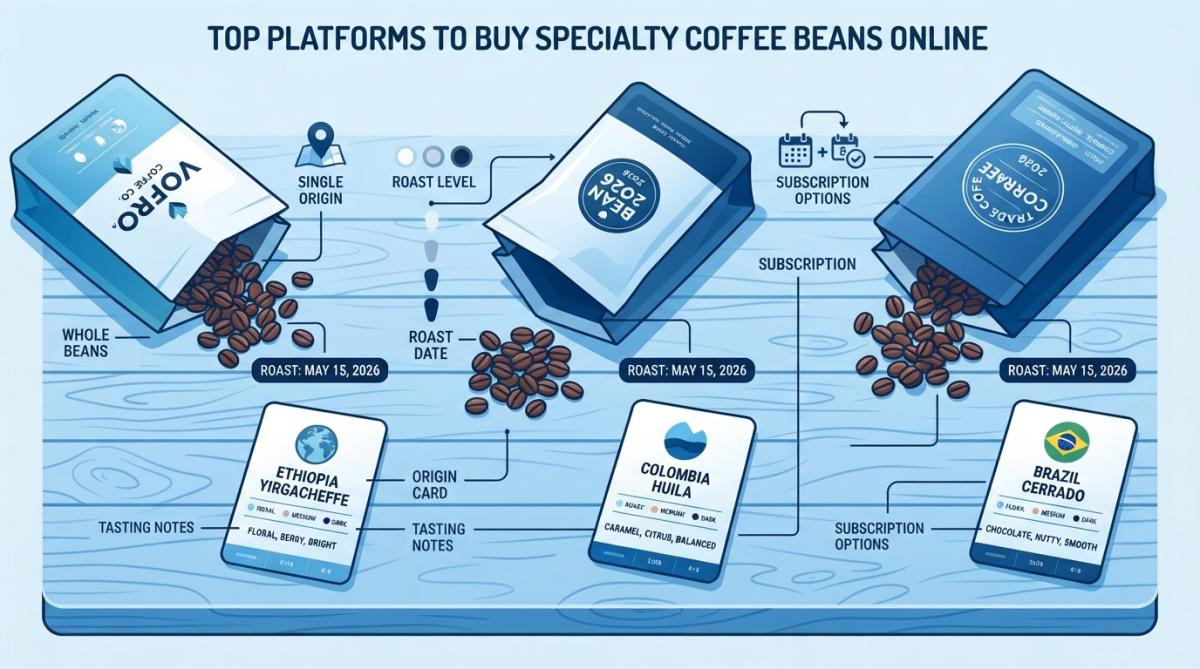
Most specialty retailers print the roast date on the bag and include tasting notes describing flavor profiles like "bright acidity with notes of blueberry and chocolate." When evaluating where to buy, look for roast dates printed prominently, single-origin options, and subscription flexibility.
Why Online Specialty Coffee Differs From Grocery Store Beans
Grocery store coffee sits in bags for months before you buy it, then months more in your pantry. By the time you brew it, volatile aromatic compounds have evaporated or oxidized, leaving a flat, one-dimensional cup.
Specialty roasters work backwards from your cup. They roast to order or in small batches, ship within days, and expect you to brew within two to three weeks of the roast date. Grocery store coffee often blends beans from multiple origins and harvest years, keeping costs low but flavor nonexistent. Specialty roasters work directly with farmers, paying premium prices for specific lots. A single-origin Ethiopian coffee from a specific washing station tastes nothing like a generic "African blend."
Freshness and Roast Dates: The Real Difference
The roast date is the most important number on any bag of specialty coffee. Freshly roasted coffee releases CO2 for 24-48 hours after roasting, which helps extract flavor during brewing. On day 2 after roasting, you'll notice a sharper, brighter cup. By day 14, the CO2 has mostly dissipated, and flavor mellows into something more balanced. By day 30, oxidation has dulled the flavor noticeably.
Most specialty roasters recommend brewing between days 3 and 21 after roasting. Day 3 gives beans time to degas slightly; day 21 is when they're still flavorful but stable. Roast date is different from best-by date, a best-by date is a guess; a roast date is a fact.
Top Platforms to Buy Specialty Coffee Beans Online
1. Venro Coffee Co.: Premium Selection with Direct Delivery
Venro Coffee Co. offers a curated selection that removes decision paralysis. You get whole bean options, signature blends, single-origin selections, and convenient single-serve capsules, all roasted to order and shipped directly to your door. The subscription model is flexible, you can customize frequency and skip months without penalty.
2. Trade Coffee: Multi-Roaster Platform with Personalized Matches
Trade Coffee partners with over 60 award-winning roasters across the United States. Their personalized recommendation quiz matches you to specific coffees based on your brewing method, flavor preferences, and roast level. All coffee is roasted to order, and most orders arrive within 5-7 business days. The subscription is flexible, and you can swap coffees between deliveries without extra fees.
3. Counter Culture Coffee: Direct Trade & Transparency
Counter Culture has sourced directly from farmers since the 1990s. You can see exactly which farms their beans came from, what price they paid, and what processing method was used. Their single-origin selection rotates seasonally. Shipping is typically 3-5 business days.
4. Blue Bottle Coffee: Meticulous Quality & Subscription Flexibility
Blue Bottle is known for obsessive quality control. Every batch is cupped (professionally tasted) before it ships. They offer 20 different subscription options, letting you customize by roast level, coffee type, or frequency. You can change your selection each month or pause without penalty.
5. Coffee Bros.: High-Scoring Specialty & Espresso Focus
Coffee Bros. specializes in coffees that score 86 points or higher on the Specialty Coffee Association scale. They're obsessive about espresso, offering multiple espresso roasts specifically designed for espresso machines. Every coffee is small-batch roasted and tested for mold and mycotoxins.
6. Wonderstate Coffee: Organic & Fair Trade Certified
Wonderstate has been exclusively organic and fair trade certified since 1996. They offer single-origins, blends, and decaf in light, medium, and dark roasts. Subscriptions include a "Roaster's Choice" option where they pick for you, removing decision paralysis.
7. Equator Coffees: Sustainable Sourcing & Curated Subscriptions
Equator Coffees has focused on sustainable harvesting since 1995. They offer curated subscriptions for espresso, decaf, blends, and single-origins, plus gift subscription options.
8. Koffee Kult: Single-Origin Focus with Brewing Guidance
Koffee Kult specializes exclusively in single-origin coffees roasted to order. They provide guidance on selecting beans based on your desired flavor profile or brewing method. Origins include Ethiopia, Sumatra, Guatemala, Brazil, and Costa Rica.

| Platform | Best For | Standout Feature | Flexibility |
|---|---|---|---|
| Venro Coffee Co. | Convenience seekers | Curated selection, no decision fatigue | High customization, skip anytime |
| Trade Coffee | Explorers | 60+ roasters, personalized matching | Swap coffees between orders |
| Counter Culture | Ethics-focused buyers | Direct trade transparency reports | Seasonal rotation, subscription flexible |
| Blue Bottle | Quality obsessives | 20 subscription options, consistent excellence | Monthly customization, pause anytime |
| Coffee Bros. | Espresso enthusiasts | 86+ point scoring, espresso-specific roasts | Limited selection, high quality |
| Wonderstate | Budget-conscious + ethical | Organic & fair trade certified | Roaster's Choice simplifies selection |
| Equator Coffees | Gift givers | Gift subscriptions available | Curated categories, straightforward |
| Koffee Kult | Single-origin explorers | Brewing method guidance | Manual orders only, no subscription |
Best Coffee Beans for Espresso Machine: Selecting the Right Roast
Espresso Blend vs. Single-Origin for Espresso
Espresso blends combine beans from multiple origins to create a balanced, sweet, clean flavor profile when extracted under high pressure. A typical blend might use 50% Brazilian beans for body, 30% Colombian for sweetness, and 20% Ethiopian for brightness. Single-origin beans work for espresso too, but they're less forgiving. Espresso blends are the safer choice if you're dialing in a new machine or learning espresso technique.
Roast Level Matters: Dark vs. Medium for Espresso
Dark roasts are traditional for espresso. The longer roast time creates oils on the bean surface that help crema (the foam) form during extraction. Medium roasts are increasingly popular for espresso because they retain more origin flavor while still working well under pressure. Light roasts rarely work for espresso. Start with a medium or dark roast espresso blend. Once your technique is solid, experiment with medium roast single-origins.
Coffee Subscription USA: Convenience Without Commitment Concerns
How Subscriptions Ensure Freshness on Your Schedule
A coffee subscription delivers beans on your schedule, ensuring you never buy stale coffee out of convenience. The best subscriptions roast to order, so your beans are roasted days before they ship. Subscriptions also solve the problem of running out, ensuring you never face a morning without good beans.
Customization Options: Avoiding Flavors You Don't Like
Good subscription services let you customize what arrives. You should be able to specify roast level (light, medium, dark), coffee type (single-origin or blend), and sometimes flavor profile (bright or bold, fruity or chocolatey). Some platforms let you rate previous coffees, and their algorithm learns your preferences.
Organic Specialty Coffee Beans: Certifications and Sourcing Transparency
Fair Trade, Direct Trade, and Shade-Grown Certifications Explained
Fair Trade certification means the farmer received a minimum price for their beans, regardless of market fluctuations. Direct Trade means the roaster bought beans directly from the farmer without a middleman. Organic certification means beans were grown without synthetic pesticides or fertilizers. Shade-grown means coffee plants grow under a canopy of taller trees, creating habitat for birds and insects.
Verifying Ethical Claims: What Proof to Look For
A roaster claiming ethical sourcing should provide specific proof: roaster name and location, specific farm names or regions, prices paid to farmers, third-party certifications (Fair Trade, Organic, Rainforest Alliance), and transparency reports. Counter Culture publishes detailed sourcing information for every coffee. If a roaster claims ethical sourcing but can't point you to specific proof, assume the claim is marketing.
Coffee Bean Types: Understanding Single-Origin vs. Blends
Single-Origin Coffees: Flavor Profile Differences by Region
A single-origin coffee comes from one country, region, or sometimes one specific farm. Ethiopian coffees tend toward bright acidity with floral or fruity notes, jasmine, blueberry, or bergamot are common. Kenyan coffees are similar but often with more body and stone fruit flavors. Colombian coffees are balanced with medium acidity, medium body, and chocolate and nut flavors. Brazilian coffees have low acidity, heavy body, and nutty or chocolatey flavors, excellent for espresso. Central American coffees (Guatemala, Costa Rica, Honduras) are balanced with chocolate, caramel, or citrus notes.
Espresso Blends and Signature House Blends
Espresso blends combine beans from multiple origins to create a balanced, clean flavor profile under espresso machine pressure. House blends are designed by the roaster to represent their style and are usually available year-round.
Whole Bean vs. Ground: Why Whole Bean Wins for Freshness
Whole beans stay fresh longer than ground coffee because they have less surface area exposed to oxygen. If you buy specialty coffee, buy whole bean. The only exception is if you don't have a grinder, in that case, ask the roaster to grind it as close to your order date as possible and brew it within a few days.
Matching Your Brewing Method to Bean Selection
Grind Size and Roast Recommendations by Brew Method
Different brewing methods extract coffee at different rates, requiring different grind sizes and roast levels.
Pour-over (Chemex, V60, Hario): Medium-fine grind, light to medium roast.
Espresso machine: Fine grind, medium to dark roast.
French press: Coarse grind, medium to dark roast.
AeroPress: Medium-fine grind, light to medium roast.
Moka pot (stovetop): Medium-fine grind, dark roast.
Turkish coffee: Extra-fine grind (powder), dark roast.
The roaster's tasting notes usually include brewing method recommendations. If they suggest pour-over but you use espresso, ask for a different recommendation.
Why Flavor Profiles Matter: Acidity, Body, and Aroma
Acidity doesn't mean sour, it means brightness and liveliness. High acidity coffees taste crisp and clean. Low acidity coffees taste smooth and heavy.
Body is the weight and thickness in your mouth. Light body coffees taste thin and clean. Heavy body coffees taste thick and creamy.
Aroma hints at flavor. If it smells like chocolate, it probably tastes like chocolate. Match these characteristics to your preferences. If you like crisp, clean coffee, look for high acidity and light body. If you like smooth, heavy coffee, look for low acidity and heavy body.
Storage and Freshness Science: Keeping Beans Peak-Ready
Roast Date vs. Best-By Date: What Actually Matters
The roast date is the only date that matters. It tells you when the beans were roasted. The best-by date is a guess, roasters typically set it 6-12 months after roasting, but that doesn't mean the coffee is actually good for that long. Beans are best between days 3 and 21 after roasting. After day 30, oxidation has noticeably dulled the flavor.
Proper Storage Containers and Shelf Life Expectations
Coffee stays freshest in an airtight container away from light, heat, and moisture. A sealed bag with a one-way valve is fine for the first two weeks. After that, transfer to an airtight container. Avoid clear containers, light degrades coffee. Avoid the freezer, coffee absorbs moisture when it thaws. Room temperature in a dark cabinet is ideal.
Whole beans stay fresh for 3-4 weeks after roasting if stored properly. Ground coffee stays fresh for 1-2 weeks. If you grind your own, grind just before brewing.
Buying specialty coffee beans online shouldn't feel overwhelming. The platforms we've covered handle freshness, sourcing, and variety so you don't have to. Venro Coffee Co. simplifies the selection with a curated range of freshly roasted beans and convenient single-serve options, all delivered directly to your door. Whether you're exploring single-origin coffees or perfecting your espresso technique, their flexible subscription and thoughtful sourcing mean you'll always have beans that taste like they should. Shop Coffee and experience the difference freshness actually makes.
Frequently Asked Questions
What makes specialty coffee beans different from regular grocery store coffee?
Specialty coffee beans are sourced from specific origins and roasted in smaller batches with attention to flavor development. They typically score 80+ points on the Specialty Coffee Association scale, feature recent roast dates (within 2-4 weeks), and come with detailed tasting notes. Grocery store coffee is often mass-produced, blended from multiple origins, and stored longer before reaching consumers, resulting in less complex flavors and reduced freshness.
How do I choose the best coffee beans for my espresso machine?
Look for beans labeled as espresso roasts or espresso blends, which are typically medium to dark roasts designed for espresso's high-pressure extraction. Check tasting notes for body and sweetness rather than acidity. Brands like Coffee Bros. specifically craft espresso roasts tested for consistency. Consider micro-lot or single-origin espresso options if you want to explore distinct flavor profiles while maintaining the body needed for quality shots.
Is it cheaper to buy specialty coffee beans online than at local coffee shops?
Specialty coffee beans purchased online are generally more affordable per cup than buying espresso drinks at cafes, though the beans themselves cost more than commodity coffee. A bag of specialty beans typically yields 15-20 cups at a lower per-cup cost than café purchases. However, you're investing in equipment, grinders, and time. Online subscriptions often provide better value than one-time purchases due to discounts, and free shipping thresholds apply when ordering above certain amounts.
How should I store specialty coffee beans to keep them fresh?
Store whole beans in an airtight container away from light, heat, and moisture, a sealed jar in a cool, dark cabinet is ideal. Avoid refrigerators and freezers, which introduce condensation. Beans stay peak-fresh for 2-4 weeks after the roast date; use them within this window for best flavor. Check the roast date on the bag before ordering, and plan consumption around that timeline. Proper storage preserves the acidity, body, and aroma that make specialty coffee worth the investment.
Can I really tell the difference between single-origin and blended specialty coffees?
Yes, if you pay attention to tasting notes and brewing method. Single-origin coffees highlight distinct regional characteristics, Ethiopian beans often show floral or fruity notes, while Brazilian beans tend toward chocolate and nuts. Blends balance flavors for consistency and body. Start by comparing two single-origins from different regions side-by-side using the same brewing method. Most coffee drinkers notice flavor differences within a few cups, especially when guided by the tasting notes provided by roasters.
This article was written using GrandRanker